

Finding Rare Books at Estate Sales: 7 Tips
Table of Contents
- What Makes a Book Rare or Collectible
- How to Identify Rare Books at Sales
- First Edition Book Identification: What Collectors Look For
- How to Value Old Books Before You Buy
- Red Flags and Common Misidentifications
- Negotiating Price and Making Your Purchase
- Safe Handling and Preservation at the Sale
- Building Your Collection with Confidence
- Frequently Asked Questions
Last Updated: October 14, 2026
What Makes a Book Rare or Collectible
A rare book isn't always old, and an old book isn't always rare, which is why rare books estate sales attract serious collectors. Rarity depends on scarcity, demand, and condition.
Books become collectible for different reasons. Some hold historical significance: a first edition of a landmark work, a signed copy, or a volume tied to a specific moment. Others are rare because few copies survived, including military history titles, out-of-print classics, and limited-run small-press publications.
Condition matters enormously. A torn dust jacket, water damage, or broken spine slashes value even if the content is historically important, as do missing pages, loose bindings, or faded text.
Provenance adds another layer. If a book belonged to a notable person, was inscribed by the author, or carries evidence of its ownership history, collectors value that story. An author-inscribed copy is worth exponentially more than an unsigned one.
How to Identify Rare Books at Sales
Finding rare books at estate sales requires a systematic approach. Most sellers don't specialise in books, so valuable titles sit unmarked alongside common paperbacks.
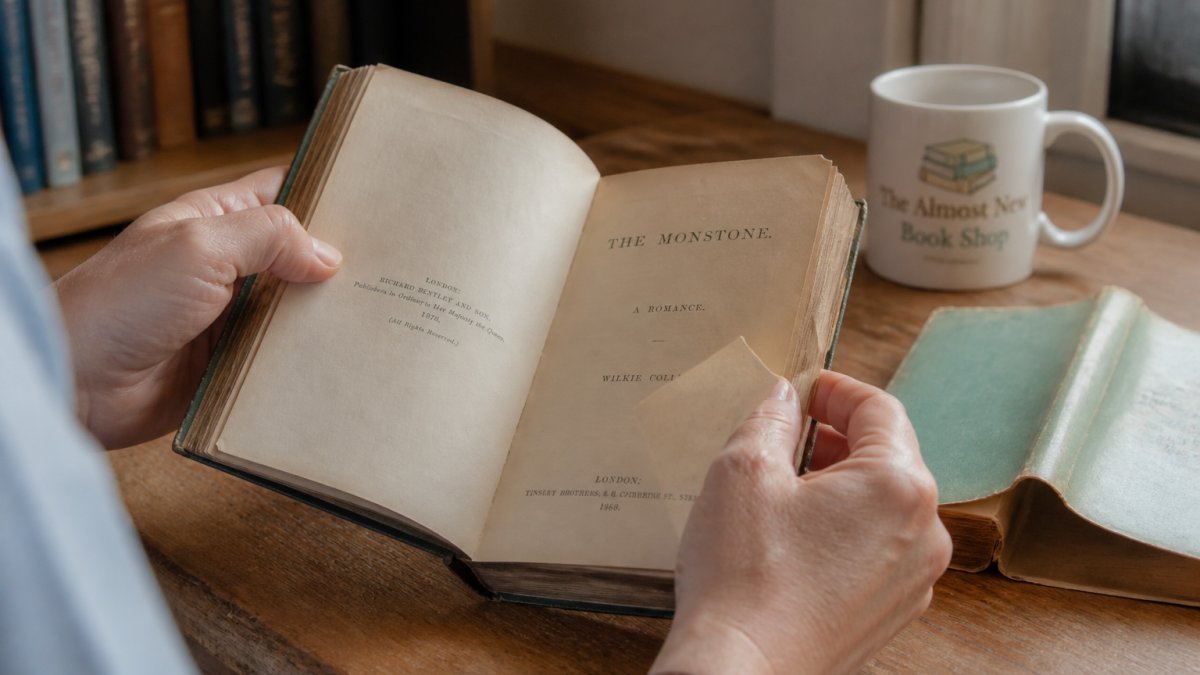
Check the Title Page and Copyright Details
The title page and copyright page reveal a book's edition and printing history. Note the publisher, publication date, and any edition statement. If it says "First Edition" or "First Printing," you've found something potentially valuable.
The copyright page sits on the reverse of the title page. Look for a print line like "10 9 8 7 6 5 4 3 2 1". If the lowest number is "1," it's a first printing; if it starts at "2" or higher, it's a later, less valuable printing. Older books may simply state "First Edition" or "First Printing" in plain text.
Age alone doesn't equal value: the combination of age, rarity, and condition determines collectibility. Scan the copyright page for notations about limited or numbered copies, which are almost always worth investigating.
Examine the Dust Jacket and Binding
The dust jacket is often the first thing collectors notice. A pristine jacket on a mid-century book can add hundreds of pounds to its value. Look for tears, fading, chips, or creasing, since even minor damage reduces value significantly. A missing jacket doesn't kill collectibility, but it lowers worth.
The binding, cover and spine, reveals production quality and age. Leather bindings, cloth-covered boards, and decorative stamping signal a premium item. Check the spine for fading or wear and feel the edges for loose sections or broken stitching. A solid binding with intact pages is far more desirable than one with structural damage.
Illustrated books deserve special attention. Look for colour plates, engravings, or decorative illustrations, which increase collectibility, particularly in art books, natural history volumes, and children's literature. Hand-coloured plates are rarer and more valuable than printed colour.
First Edition Book Identification: What Collectors Look For
First edition identification separates casual browsers from serious collectors. Understanding publishers' different methods unlocks significant value at estate sales.
The most straightforward indicator is a copyright page statement. American publishers often print "First Edition" or "First Printing" explicitly; British publishers may use "First Published" or simply the year without a print line.
The print line, that descending sequence of numbers, is the gold standard.
Some publishers don't use print lines at all, simply omitting any edition statement on the copyright page, which means it's the first edition.
Dust jackets provide additional clues. First edition jackets often carry the original publication price on the flap; later printings may have revised prices or different cover art. A jacket matching the first edition's publication date with the original price intact strengthens the case for a genuine first printing.
How to Value Old Books Before You Buy
Pricing rare books requires research, but you don't need to be an expert. A few simple steps help you avoid overpaying and identify genuine bargains.
Start by searching online for comparable sales. Rare book websites list sold copies with final prices, giving you a realistic market value.
Check multiple sources. Different platforms serve different markets and price points, and that variation gives you negotiating room.
Consider rarity carefully. A book that sold five years ago for £80 may now fetch £120 if fewer copies have appeared since, while one scarce a decade ago might be reprinted and cheaper now.
At estate sales, sellers rarely price books individually based on rarity, so valuable titles often cost the same as common paperbacks. If you've identified a book worth £60 priced at £3, you've found genuine value.
Red Flags and Common Misidentifications
Not every old book is valuable, and some that look rare are common reprints. Spotting red flags saves money and frustration.
Reprints masquerade as first editions more often than you'd think. A facsimile reprint, a modern reproduction of an older edition, will state "Reprint Edition" or "Facsimile Edition" on the copyright page.
Book club editions are another common trap. Publishers created special editions for book clubs, often with different bindings or paper quality.
Dust jacket reproductions fool many buyers. If a book is missing its original jacket, some dealers add a modern reproduction. These are clearly inferior: colours too bright, different paper feel, different printing quality.
Formula 1 Yearbook 1997–1998 →
Water damage and mould are dealbreakers. A book with water stains, foxing (brown age spots), or visible mould may be unsalvageable and could damage other books.
Misattributed authorship is rarer but happens.
Negotiating Price and Making Your Purchase
Estate sale pricing is often negotiable, particularly toward the end when organisers want to clear stock. Knowing how to negotiate gets better prices without disrespecting the seller.
Arrive early and browse thoroughly. Serious collectors show up on day one, so competition is fierce and prices hold firm.
Bundle purchases work in your favour. Buying five books instead of one justifies asking for a discount on the total, since sellers appreciate bulk sales that reduce handling and storage.
Know when to walk away. If a book is priced above market value and the seller won't budge, don't buy it.
Document everything. Photograph the cover, dust jacket, title page, and copyright page before leaving.
Payment methods matter too. Cash often gives you negotiating use. Sellers appreciate immediate payment without processing fees. If you're spending significant money, offering cash can justify a modest discount.
Safe Handling and Preservation at the Sale
How you handle books at an estate sale affects their condition and resale value. Proper technique protects your investment.
Never force a book open. Spines break when books are bent too far backward. Open gently, supporting the spine with both hands, and let pages fall naturally rather than fanning them.
Keep books away from moisture. Estate sales often take place in garages, basements, or outdoors where humidity is high, and moisture damages bindings and pages rapidly.
Stack books carefully. Carry multiple purchases flat rather than upright, since vertical stacking puts pressure on spines. Lay books flat in a bag or box to distribute weight evenly.
Inspect for pests before bringing books home. Look for small holes, insect droppings, or signs of silverfish or bookworms.
Store newly acquired books in a cool, dry place for at least 48 hours before integrating them into your collection.
| Handling Step | Action | Why It Matters |
|---|---|---|
| Opening books | Support spine, let pages fall naturally | Prevents spine breaks and page damage |
| Transporting | Stack flat, keep dry | Protects binding and paper integrity |
| Storage | Cool, dry location, quarantine 48 hours | Prevents pest spread and moisture damage |
| Inspection | Check for holes, droppings, discolouration | Catches problems before they spread |
Building Your Collection with Confidence
Estate sales offer unparalleled opportunities to find rare books at prices you won't see elsewhere. The key is combining knowledge with patience: research before you go, inspect carefully, and don't rush decisions.
Start small. Your first purchases teach you what you value and how to identify genuine bargains. As your eye develops, you'll spot quality faster and negotiate more effectively. Every collector's library began with a single estate sale find.
Connect with other collectors. Online communities and local book clubs share knowledge about upcoming sales, pricing trends, and identification techniques, accelerating your learning.
Consider specialising. Rather than collecting everything, focus on a specific genre, era, or author. Specialisation deepens expertise and makes research more efficient: a collection of military history first editions becomes more valuable and coherent than a random assortment of old books.
When you find exceptional books at estate sales, remember they can find new homes through platforms connecting collectors with rare titles. We rescue books from landfills and match them with collectors and readers who appreciate their value, whether historical significance, sentimental worth, or the joy of a well-loved story.
Finding rare books at rare books estate sales rewards preparation and persistence. Get started with The Almost New Book Shop and discover how pre-loved books find their next readers at prices that make collecting sustainable and enjoyable. Join our community of book lovers and subscribe to our newsletter
Frequently Asked Questions
What should I look for when buying books at an estate sale?
Start by examining the title page and copyright page to identify the edition and publication date. Check the dust jacket for tears or damage, and inspect the binding for wear. Look for author signatures or inscriptions, which add value. Scan the pages for annotations or stains. Handle the book carefully to assess its overall condition. Take photographs of key pages if allowed, then research comparable sales online before making an offer. Rare books at estate sales often go unrecognised, so knowledge is your advantage.
How can you tell if a book is rare or valuable?
Rarity depends on scarcity, condition, and demand. Check whether it's a first edition or first printing, look at the edition statement on the copyright page. Verify the author's name and publication date match known editions. Examine the dust jacket, binding quality, and any illustrations or special features. Research the book's provenance and printing history using online price guides and comparable sales listings. Books by sought-after authors, limited print runs, and those in excellent condition command higher prices. Military history, classics, and signed copies are particularly collectible.
How do I know if a book is a first edition?
Check the copyright page (usually the back of the title page) for an edition statement. A first edition typically says 'First Edition' or 'First Printing' explicitly, or shows only the year of publication without later years listed. Some publishers omit edition numbers on first printings, so absence of a statement can mean first edition. Look for the publisher's name and address, these change between printings. Compare your book's details against known editions in online databases. The dust jacket may also state 'First Edition,' though this is less reliable than the copyright page.
What types of books are most sought after by collectors?
First editions by celebrated authors are highly collectible, especially classics and literary fiction. Military history attracts dedicated collectors willing to pay premium prices. Signed or inscribed copies command significant premiums. Illustrated editions, particularly children's books with original artwork, are in demand. Out-of-print titles in good condition appeal to readers seeking books no longer available new. Vintage reference books, technical manuals, and period-specific titles interest specialists. Condition matters enormously, a pristine dust jacket can multiply a book's value tenfold compared to the same book without one.
How can I check a rare book's edition and publication date?
Open the book to the copyright page, located on the back of the title page. This page lists the publication date, publisher, and edition information. Look for 'First Edition' or 'First Printing' statements, or check whether multiple years are listed (indicating reprints). The publisher's address and logo may help identify the edition, as these details change over time. Cross-reference your findings with online book databases and price guides. Photograph the title page and copyright page for your records. If the copyright page is unclear, examine the dust jacket, binding design, and printing quality, these often differ between editions.