

7 Ways to Identify Valuable Old Books: UK Guide
Table of Contents
- Why Some Old Books Are Worth More Than You Think
- First Edition Book Identification Guide: Spotting the Clues
- Book Condition Grading Standards: What Collectors Look For
- Dust Jackets, Bindings and Rare Materials
- Provenance: The Story Behind the Book
- Where to Sell Rare Books UK: Auction Houses and Dealers
- Common Beginner Pitfalls and How to Avoid Them
- Conclusion: Turning Your Shelf into a Treasure Hunt
- Frequently Asked Questions
Last Updated: September 16, 2026
Why Some Old Books Are Worth More Than You Think
The gap between a car boot curiosity and valuable old books usually comes down to a handful of physical details, not the age of the book itself. At The Almost New Book Shop, we handle thousands of pre-loved volumes and see the same pattern repeatedly: a book from 1890 can be worth less than one from 1975, because scarcity, condition and demand matter more than the number printed on the copyright page.
First Edition Book Identification Guide: Spotting the Clues
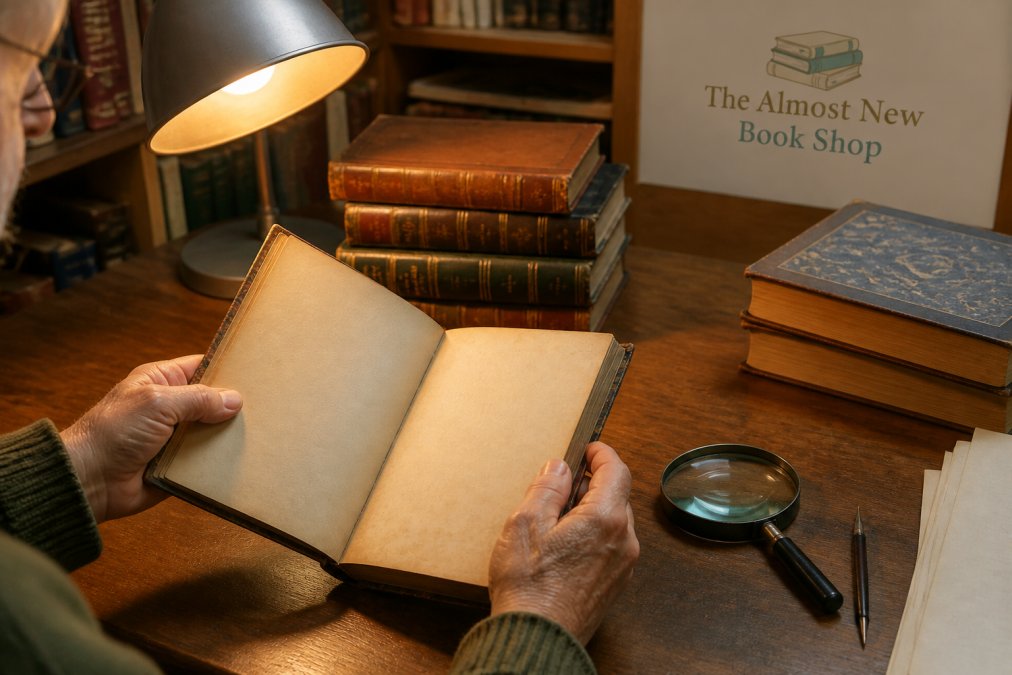
First edition book identification is the single most important skill in this hobby, and it starts with the title page, not the cover. A true first edition is the first printing of the first edition of a work, and publishers mark this in specific, checkable ways.
Title Page and Copyright Date Checks
The title page is the page that names the book, author and publisher, and it is the page collectors trust. A copyright date alone proves nothing, because reprints carry the same date as the original.
Check these in order:
- The publisher's name matches the first edition publisher
- No mention of "reprinted" or "new edition"
- The copyright page lists no later printing numbers
- The impression line (often "First published 19XX") is intact
Impression, Issue and State
Impression, issue and state are the technical terms that separate a true first from a later printing. An impression is a single print run. An issue is a group of copies altered before release. State refers to changes made during a single printing.
Book Condition Grading Standards: What Collectors Look For
Book condition grading standards run from Fine down to Poor, and condition can swing a valuation more than the edition itself. A Fine first edition might be worth ten times a Good copy of the same book, so grading honestly matters.
| Grade | Description | Value Impact |
|---|---|---|
| Fine | Near-new, no flaws | Highest |
| Very Good | Minor wear, tight binding | Strong |
| Good | Read copy, some foxing | Moderate |
| Fair | Heavy wear, loose spine | Low |
| Poor | Missing pages, damaged boards | Minimal |
Foxing, Spine Wear and Board Damage
Foxing is the brown spotting that appears on old paper, caused by age and moisture. It lowers value, but a little foxing on a genuinely scarce title is often acceptable to collectors.
Dust Jackets, Bindings and Rare Materials
A dust jacket can double or triple a book's value, and this surprises almost every beginner. Publishers often discarded jackets, so a surviving example in good condition is genuinely scarce.
Provenance: The Story Behind the Book
Provenance is the documented history of a book's ownership, and it is the angle most guides skip entirely. A signature, bookplate, inscription or accompanying letter can transform an ordinary copy into a desirable one.
Where to Sell Rare Books UK: Auction Houses and Dealers
Choosing where to sell depends on the book's value, how quickly you want the money, and how much risk you are willing to carry. The UK market splits into three broad tiers, and each behaves differently.
The three tiers of the UK trade
- Regional auction houses: the practical starting point for most finds. Salerooms in market towns and county centres run regular book, ephemera and collectors' sales, often monthly. They typically charge a seller's commission plus a lotting fee and may add a charge for photography or insurance. Estimates are usually conservative, and a modest book can sell for £10-£80. The advantage is low cost of entry; the disadvantage is a thin buyer pool for specialist material.
- London specialist houses: the right route for genuinely scarce titles, signed first editions, and anything with strong provenance. These salerooms run dedicated book and manuscript sales, publish catalogues, and attract international bidders. Commission is higher and there is usually a minimum lot value below which they will not take the consignment. The trade-off is reach versus cost.
- Antiquarian and second-hand dealers: faster and simpler. A dealer will usually make a direct offer, often 30-50% of what they expect to resell for. You trade upside for certainty and same-week payment.
What actually happens at a UK auction
When you consign, the house agrees a reserve (the minimum price below which the book will not sell) and an auction estimate (the printed range). If the hammer falls at or above the reserve, the book sells and the buyer pays a buyer's premium on top of the hammer price, that premium goes to the auction house, not to you.
Choosing between them
| Route | Speed | Typical cost to you | Best for |
|---|---|---|---|
| Regional saleroom | Weeks | Commission + lotting fee | Mid-value finds, local demand |
| London specialist | Months | Higher commission, minimum lot value | Scarce, signed, provenance-rich titles |
| Antiquarian dealer | Days | Implicit in the offer price | Convenience, certainty |
| Online marketplace | Variable | Your time, postage, fees | Common titles with steady demand |
For everyday books that will never justify a saleroom, a local charity shop or a dealer is the sensible route. If you simply want to rehome ordinary titles responsibly, [The Almost New Book Shop's gift card | https://thealmostnewbookshop.net/products/the-almost-new-book-shop-gift-card] is a simple way to pass a love of reading onward.
The Almost New Book Shop gift card →

Common Beginner Pitfalls and How to Avoid Them
Most guides list the same four mistakes and stop. The traps that actually cost beginners money are more specific, and they cluster around a handful of formats that look old but are not.
The reprint trap
A reprint is a later printing of an existing edition. It can carry the original copyright date, reproduce the original title page, and look indistinguishable from a first edition at a glance. The giveaway is usually on the copyright page or the impression line: a statement such as "First published 1923" followed by "Reprinted 1951, 1968, 1974" tells you exactly what you are holding.
The leather-bound illusion
A handsome leather binding does not make a book rare. Many ordinary Victorian and Edwardian titles were rebound in leather by their owners, and a rebound book is worth less than one in its original cloth, not more. Worse, a large volume of modern leather-bound reprints of classic texts is sold by subscription and looks convincingly antique.
The book club edition
Book club editions are legitimate printings, but they are not first editions and they are rarely collectible. They are usually smaller, thinner, and marked on the copyright page or the dust jacket flap. If the jacket mentions a book club, treat the copy as a reading copy, not a collectible.
The print-on-demand facsimile
A facsimile is a photographic reproduction of an original. Modern print-on-demand services produce facsimiles of out-of-copyright titles that can look old on the shelf. Tell-tale signs include uniform, slightly fuzzy text, a perfect-bound spine rather than a sewn one, and a copyright page that references a modern publisher or a print-on-demand platform.
Other frequent errors
- Overvaluing a book because of age alone
- Ignoring condition in favour of edition
- Discarding the dust jacket as packaging
- Trusting a single valuation source without cross-checking
- Assuming a signature is the author's without comparing it to a known example
What most guides miss is that scarcity and demand do the heavy lifting. A book can be old, handsome and completely common. Verify before you celebrate.
Conclusion: Turning Your Shelf into a Treasure Hunt
Identifying a genuinely collectible book takes ten minutes of careful inspection, not years of expertise. Check the title page, grade the condition, look for a dust jacket, and trace the provenance. That sequence catches most real finds and saves you from the common traps.
Frequently Asked Questions
How can I find out if my old books are worth anything?
Start by checking the title page for a first edition statement and the copyright date. Compare your copy against descriptions on specialist bookseller sites, noting condition details like foxing or spine wear. If it looks promising, get a free auction estimate from a UK auction house or consult a rare book dealer. Provenance, such as inscriptions or bookplates, can add value. Always handle books gently and avoid cleaning them before appraisal.
What are the most sought-after old books?
High demand exists for first editions of literary classics, early children's books with dust jackets, and military history titles with maps or plates. Condition is critical: a fine copy in its original dust jacket can be worth many times a reading copy. Scarcity, provenance, and whether the book is out-of-print all drive interest. UK collectors often prize books with local connections or those published in small print runs.
Are books over 100 years old worth anything?
Age alone does not guarantee value. Many 19th-century books are common and sell for a few pounds. Value depends on scarcity, condition, and demand. A 100-year-old book in poor condition with foxing and a damaged spine may be worth little, while a rare first edition in fine condition could fetch hundreds. Check publisher information, binding, and whether it is a facsimile or reprint before assuming it is valuable.
How do I identify a first edition book?
Look for 'First Edition' or 'First Impression' on the copyright page. Some publishers use a number line (e.g., 10 9 8 7 6 5 4 3 2 1) where the lowest number indicates the printing. Check the title page for the original publication date and compare it to the copyright date. For older books, absence of later edition statements can be a clue. Consult a first edition book identification guide for your specific publisher.