

How to Clean and Restore Old Book Covers
Table of Contents
- Assess Your Book's Condition Before You Start
- Remove Loose Dust and Surface Dirt Safely
- How to Clean Cloth Book Covers
- How to Clean Leather Book Covers
- Dealing with Mildew on Books
- Essential Book Conservation Tools and Materials
- Cleaning Paper Covers and Dust Jackets
- Aftercare and Preventive Preservation
- Frequently Asked Questions
Last Updated: October 12, 2026
Assess Your Book's Condition Before You Start
Before any cleaning method, understand what you're working with: condition determines whether gentle cleaning helps or causes damage.
Examine the spine, hinges, and page edges. Visible tears, loose cloth, or separated leather mean the book needs professional restoration, not home cleaning.
Identifying cover materials
Cloth covers feel soft and flexible, usually cotton or linen blended with synthetic fibres.
Leather covers feel smooth or slightly textured, warm to the touch, sometimes with a subtle shine.
Paper covers, including dust jackets, are thin and flexible and need the gentlest approach.
Coated or laminated covers feel smooth and slightly plastic with a visible sheen.
A material-first decision guide
Work top to bottom and stop at the first row that matches your book.
-
Is the cover flaking, powdery, or shedding fibres? Stop. Do not clean. Flaking leather and friable paper lose material with every touch; seek a conservator.
-
Is there active mould, a strong musty smell, or visible insect damage? Stop and isolate the book from the rest of your collection. See the mildew section below before doing anything else.
-
Is the book valuable, signed, first-edition, or pre-1900? Treat any cleaning as a risk to value; a conservator's assessment costs far less than a botched clean.
-
Is the cover coated, laminated, or glossy? Use dry methods only: a soft brush and a museum-grade dry-cleaning sponge. Avoid water and solvents.
-
Is the cover paper or a dust jacket? Use dry methods only. Never wet paper.
-
Is the cover cloth? Dry-clean first. Move to a barely damp cloth only if dry methods leave residue.
-
Is the cover leather in sound condition? Clean lightly, then condition. Never clean leather without conditioning afterwards.
Spotting damage that needs professional restoration
Some damage is beyond home care. If you see these signs, stop and consider professional restoration:
- Mould growth (fuzzy patches, musty smell)
- Severe water damage or warping
- Separated hinges or spine
- Leather that's cracked, flaking, or peeling
- Torn pages or loose bindings
- Foxing (brown stains) that's extensive
- Unstable pigments or inks that smudge when touched with a dry tissue
- Previous repairs using pressure-sensitive tape, which often stains and embrittles over time
These require specialist knowledge and equipment; home cleaning can make them worse.
Document before you clean
Photograph the cover, spine, and any damage from several angles in even, natural light before you begin, and note the date and methods used. This record shows whether a treatment worked and is essential for a conservator or insurance claim.
Testing a cleaning method on an inconspicuous area
Whatever method the decision guide points to, test it first on a hidden area such as the bottom corner of the back cover. Apply it exactly as you would on the visible cover, wait at least ten minutes, and check for colour transfer, darkening, pilling, or loss of surface. If anything worsens, stop and try a drier method. A test that passes on one book does not guarantee success on another.
Remove Loose Dust and Surface Dirt Safely
This step prevents dirt from becoming embedded during wet cleaning.
Use a soft brush or dry-cleaning sponge, brushing outward from the spine.
For the dust jacket, hold it firmly and brush one side at a time.
Pay special attention to the top edge of the pages and the fore-edge (the front edge), where dust accumulates.
If your book has a musty smell but no visible mould, air it in sunlight for a few hours.
How to Clean Cloth Book Covers
Cloth covers respond well to gentle cleaning because the fibres are relatively durable. Use minimal moisture and the right tools.
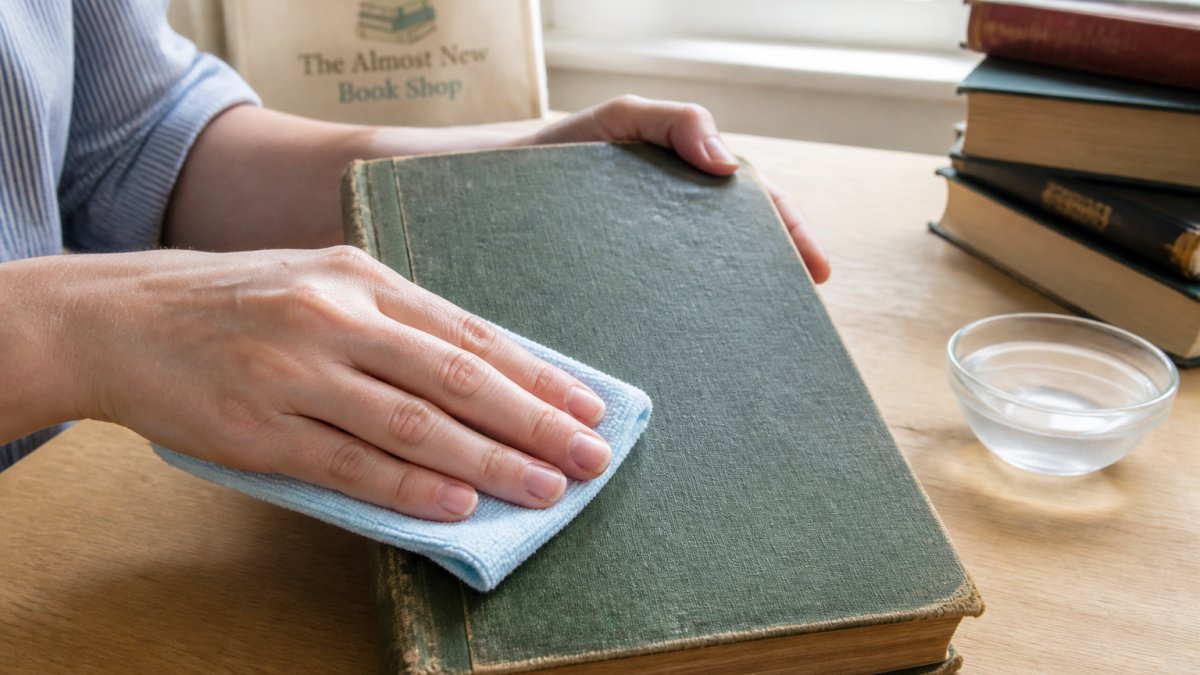
Testing your cleaning method first
Before cleaning the whole cover, test on an inconspicuous area, the bottom corner of the back cover is ideal.
Wring a cloth out thoroughly so it's barely damp, press it against the test area for a few seconds, and look for colour transfer, pilling, or damage to the weave.
If the test area shows no problems after 10 minutes, proceed.
Step-by-step cleaning process
Step 1: Prepare your materials. You'll need a soft cloth (microfibre or cotton), distilled water, and a soft brush.
Step 4: Dry immediately. Pat gently with a dry cloth rather than rubbing.
Step 5: Air dry completely. Leave the book open and upright in a well-ventilated room for several hours.
For stubborn stains on cloth, a museum-grade dry-cleaning sponge works better than water. Press and lift repeatedly rather than rubbing.
How to Clean Leather Book Covers
Leather needs conditioning, not just cleaning. Dry leather cracks and deteriorates.
Why leather requires different care
Leather loses moisture over time, especially in heated homes or dry climates, becoming brittle and prone to cracking. Cleaning without conditioning leaves it worse than before.
Old leather also develops a patina that adds character and value; aggressive cleaning removes it.
Cleaning and conditioning leather safely
Start with the same gentle dust removal as cloth covers, using a soft brush.
For cleaning, use a leather-specific cleaner or equal parts white vinegar and distilled water.
Wipe gently in small sections, never soaking the leather or letting moisture sit. Dry immediately with a clean cloth.
Let it absorb for 30 minutes, then buff off any excess with a dry cloth.
Condition leather annually in dry environments; humid climates need it less often.
Dealing with Mildew on Books
Mildew is a fungal growth that thrives in damp conditions. It is really a containment and environment problem: clean the book without fixing the conditions that caused the growth and it will return.
Identifying mildew versus other stains
Mildew appears as fuzzy grey or black patches, sometimes with a white powdery bloom and a musty, earthy smell. The patches feel slightly raised and may smear under a dry finger.
Foxing (age spots) looks like brown or tan stains but feels flat, has no smell, and does not spread.
Water stains are brown or yellow with a defined edge, often a tidemark, and neither smell musty nor spread.
Is the mildew active or dormant?
This distinction decides everything that follows.
- Active mildew is soft, may smear, and often smells strongly. It grows when relative humidity stays above roughly 65% for a sustained period and needs containment and environmental correction, not just cleaning.
- Dormant mildew is dry, powdery, and does not smear, residue of past growth. It often brushes away, but the spores remain and reactivate if conditions allow.
If you cannot tell which you have, treat it as active.
Containment before cleaning
Mildew spreads by spores, and every brush stroke can release them onto nearby books.
- Isolate the book. Bag it in a sealed polyethylene bag, away from the rest of your collection, until treated.
- Work outdoors or in a well-ventilated space away from other books, soft furnishings, and food preparation areas.
- Wear a mask and gloves. A disposable respirator rated for fine particles is appropriate; spores irritate the lungs and can trigger allergic reactions.
- Lay down a disposable sheet you can wrap up and bin afterwards.
- Do not use a household vacuum on mouldy books, standard vacuums exhaust spores back into the room. Use a HEPA-filtered vacuum, or brush gently outdoors.
Safe removal methods and when to stop
If mildew covers more than about a tenth of the cover, has penetrated the pages, or the book is valuable, stop and consult a conservator. Home cleaning won't stop active growth and can drive spores deeper into the binding.
For small, dormant surface mildew on covers:
- Brush it away outdoors with a soft, natural-bristle brush, working away from your face and the spine.
- Wipe the area with a cloth barely dampened in white vinegar diluted with an equal part of distilled water, which inhibits surface mildew growth. Dry immediately with a clean cloth.
- Air the book in indirect sunlight for several hours. Direct sun fades covers and over-dries leather, so use a shaded, airy spot.
Never use bleach on books; it permanently damages paper and cloth fibres, sometimes invisibly for months.
Treating insect activity
Insect damage often turns up alongside mildew, since both thrive in the same damp, undisturbed conditions.
- Look for small round holes, grazed cover edges, and gritty frass in the gutter or between pages.
- Empty the frass outdoors and brush the book gently.
- Freeze the book in a sealed bag only if you're confident it can tolerate freezing, cold can damage some adhesives, photographic materials, and coated papers.
- For any book of value, or an infestation affecting more than one volume, consult a conservator or specialist bookbinder.
Preventing return
After treatment, the book needs a stable, dry environment or mildew will return.
- Store the book in a dry location with good air circulation. Avoid sealed plastic boxes for long-term storage, which trap residual moisture.
- Aim for a stable relative humidity of 40-50%. Below 30% risks drying and cracking leather; above 60% invites mould.
- Keep the book away from external walls, basements, and attics, where humidity fluctuates most.
- Check the book every few weeks for the first few months. If mildew returns within weeks, the storage environment is the problem, not the cleaning.
- Consider a dehumidifier, or move the collection to a drier part of the home.
If several books are affected, treat them one at a time and keep each isolated until stable.
Essential Book Conservation Tools and Materials
The right tools make cleaning safer and more effective.
A dry-cleaning sponge (museum-grade) lifts dirt without water and is gentler than traditional rubber erasers.
Distilled water prevents mineral deposits. Tap water leaves marks on cloth and leather.
Microfibre cloths are ideal because they don't shed fibres; cotton works if microfibre isn't available.
White vinegar inhibits mildew and cleans leather safely. Use equal parts vinegar and distilled water.
Investing in these tools is recommended if you care for books regularly. They're affordable and last for years.
Cleaning Paper Covers and Dust Jackets
Paper is the most fragile material. It tears easily and water damage is permanent.
Never wet paper covers. Instead, use a dry-cleaning sponge or soft brush.
For dust jackets, support the book firmly underneath. Dust jackets are loose and tear easily.
For small tears, use acid-free archival tape designed for book repair; regular tape yellows and damages paper over time.
Aftercare and Preventive Preservation
Cleaning is only half the job, storage determines whether a book stays clean.
Keep books out of direct sunlight, which fades covers and weakens paper fibres.
Maintain consistent temperature and humidity. Fluctuations cause warping and mould growth.
Avoid damp basements and hot attics, which accelerate deterioration.
Handle books with clean hands; skin oils and dirt transfer to covers over time.
Caring for old book covers doesn't require professional equipment or years of experience.
Frequently Asked Questions
What is the best way to clean old book covers without damaging them?
Start by assessing the cover material and testing your cleaning method on a hidden area first. For cloth covers, use a soft brush to remove dust, then a dry-cleaning sponge with minimal moisture. For leather, use a leather-specific cleaner applied sparingly. Always work gently and from the spine outward to avoid lifting fibres. Stop immediately if the cover shows signs of damage or the material begins to deteriorate.
How do you clean a leather book cover safely?
Leather requires gentler handling than cloth. First, remove surface dust with a soft brush. Test any cleaning product on the inside of the back cover first. Use a leather-specific cleaner or a barely damp cloth with distilled water, applied sparingly. Wipe in one direction, never scrubbing. After cleaning, apply a leather conditioner to restore flexibility and prevent cracking. Avoid harsh chemicals or excessive moisture, which can cause permanent staining or warping.
What book conservation tools do you really need for home cleaning?
Essential tools include a soft brush (natural bristles), a dry-cleaning sponge or museum-grade sponge, distilled water, lint-free cloths or paper towels, and cleaning putty for lifting surface marks. For leather, add a leather-specific cleaner and conditioner. You do not need expensive specialist equipment for basic surface cleaning; most effective tools are affordable and widely available. Avoid harsh household cleaners, which can damage bindings and paper fibres.