

Sustainable Ways to Source Children's Books in 2026
Table of Contents
- Quick Comparison: 7 Sustainable Sourcing Routes
- 1. Second-Hand Shops: The Fastest Route to Sustainable Children's Books
- 2. The Environmental Case: Benefits of Pre-Loved Children's Books
- 3. What to Look For in Eco-Friendly Children's Book Retailers
- 4. Library Loans and Book Swaps: Community-Led Sourcing
- 5. How to Donate Children's Books (and Where They Actually Go)
- 6. Caring for Pre-Loved Books So They Last Longer
- 7. Building a Sustainable Children's Library on a Budget
- Frequently Asked Questions
Last Updated: September 29, 2026
Quick Comparison: 7 Sustainable Sourcing Routes
Sustainable ways to source children's books have moved from niche hobby to mainstream habit, and for good reason. At The Almost New Book Shop, we help families build entire shelves without buying a single new copy. The seven routes below range from free to cheap, and every one of them keeps a book in circulation instead of in a bin.
| Route | Cost | Effort | Best For |
|---|---|---|---|
| Second-hand shops | £1.99-£7.99 | Low | Fast, reliable finds |
| Pre-loved online | Low | Low | Specific titles |
| Eco-friendly retailers | Medium | Low | New-but-green buys |
| Library loans | Free | Low | Try-before-you-buy |
| Book swaps | Free | Medium | Community building |
| Donation schemes | Free | Medium | Decluttering with purpose |
| Repair and reuse | Minimal | Medium | Making favourites last |
1. Second-Hand Shops: The Fastest Route to Sustainable Children's Books
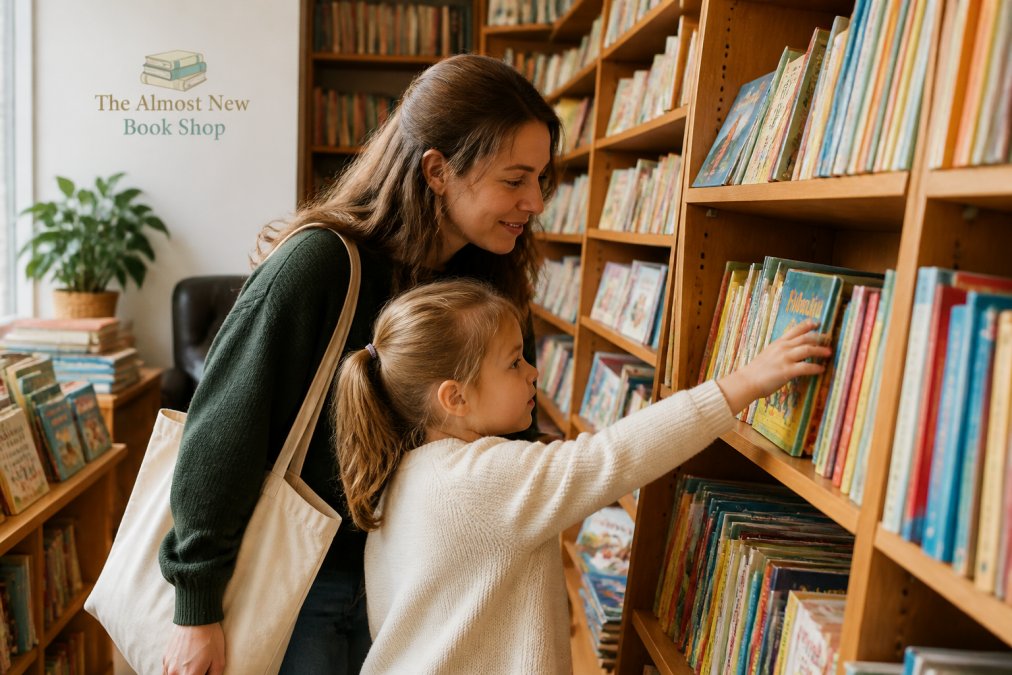
A second-hand shop is the quickest way to put a quality book in a child's hands for a couple of pounds. You skip the manufacturing footprint entirely because the book already exists. No new paper, no new ink, no new shipping from a printer.
2. The Environmental Case: Benefits of Pre-Loved Children's Books
Buying pre-loved is the single biggest environmental win available to a reading family. Every reused book avoids new pulp, new printing, and new transport. The benefits of pre-loved children's books stack up fast: lower carbon footprint, less landfill, and more money left for more stories.
Lifecycle of a Book: From Print to Landfill
A new book's journey starts with felled trees, moves through pulping, printing, binding, and distribution. A pre-loved book skips straight to its second reader. That circular economy approach keeps the same paper working for decades rather than months.
3. What to Look For in Eco-Friendly Children's Book Retailers
Eco-friendly children's book retailers should be judged on materials, packaging, and honesty, not slogans. Look for post-consumer recycled paper, vegetable-based inks, and plastic-free packaging.
Recycled Paper, Vegetable Inks and Plastic-Free Packaging
Three markers separate genuine eco-friendly printing from greenwashing:
- Recycled content: post-consumer recycled paper or natural unbleached paper
- Inks: vegetable-based inks rather than petroleum-derived alternatives
- Packaging: plastic-free packaging, ideally recycled or biodegradable materials
A responsible publisher will state these openly. Ethical sourcing also covers where the book was printed; local manufacturing cuts transport emissions sharply.
How to Verify a Green Claim Before You Buy
Slogans are cheap; paperwork is not. A few checks separate a genuine eco-friendly edition from a greenwashed one:
- Paper grade: ask whether the stock is FSC-certified or carries the EU Ecolabel. Both are third-party schemes with public registers, so a claim can be checked rather than trusted.
- Ink type: vegetable-based inks (soy, linseed, or similar) are the common alternative to petroleum-derived inks. Publishers who use them usually say so on the imprint page.
- Board vs paperback: board books use more material per title but survive far longer, so for babies and toddlers a sturdy board edition often beats a flimsy paperback on lifetime impact.
- Print origin: a book printed domestically travels a fraction of the distance of one shipped from overseas. Where the printer is named, that is a useful signal.
- End-of-life: paperbacks are widely recyclable once the cover and any plastic lamination are removed. Heavily laminated or foil-stamped covers are harder to recycle, so simpler finishes are the greener choice.
The Trade-Offs Nobody Mentions
A new eco-friendly book still carries a manufacturing footprint that a pre-loved copy does not. Recycled paper and vegetable inks reduce that footprint; they do not erase it. So the honest hierarchy is: borrow first, buy pre-loved second, buy new-but-green third. Treat eco-friendly retail as the option for titles you genuinely cannot find second-hand, such as new releases or specific curriculum reads.
4. Library Loans and Book Swaps: Community-Led Sourcing
Libraries remain the most underused sustainable source of all. A library card gives your child access to thousands of titles for free, and book circulation is resource conservation in its purest form. Return the book, and someone else reads it next.
Why the Library Beats Every Other Route on Impact
A borrowed book is read many times over by many families, and no new copy is printed for each reader. That is the circular economy working at scale, funded by council budgets rather than your wallet. Most library services also run reservations, so a title you cannot see on the shelf can usually be requested from another branch and collected locally.
My Naughty Little Sister — Dorothy →
- Join once and keep the card number handy for online reservations
- Reserve titles a week ahead so they are waiting when you visit
- Use the children's section as a browsing space, not a checklist
- Note return dates and renew online to avoid charges
- Ask staff about inter-library loans for anything not stocked locally
How to Run a Book Swap at School or Nursery
- Pick a date and a covered space, indoors or out
- Ask families to bring up to five good-condition books
- Sort donations by age group onto labelled tables
- Set a simple rule: bring books, take books
- Add a donation box for leftovers
- Repeat termly so it becomes a habit
The Lifecycle Question: Library, Swap or Buy?
Every route has a different footprint, and the trade-offs are worth understanding:
- Library loan: lowest impact. One copy serves dozens of readers, and the library absorbs the printing and transport cost once.
- Book swap: very low impact. Books already in your community change hands with no new manufacturing and almost no transport.
- Pre-loved purchase: low impact. The book is reused, though it may have travelled to reach you.
- New eco-friendly purchase: moderate impact. Recycled paper and vegetable inks reduce the footprint but do not remove it.
- New standard purchase: highest impact of the five, because it combines virgin paper, conventional inks and distribution.
5. How to Donate Children's Books (and Where They Actually Go)
Donating is easy; donating usefully takes a little thought. Charity shops, school libraries, nurseries, and hospital play teams all take children's books, but they need clean, complete copies.
6. Caring for Pre-Loved Books So They Last Longer
A well-kept paperback can survive several childhoods. Store books upright on a shelf, away from direct sunlight and radiators, because damp and heat are the two biggest killers. A dry, ventilated room does most of the work for you.
7. Building a Sustainable Children's Library on a Budget
You can build a serious children's library for the price of a few takeaways. Mix free routes with cheap purchases and let quality guide you. A Jacqueline Wilson paperback at £1.99 or The Midnight Fox at £3.50 adds real value for pocket change.
Frequently Asked Questions
Are second-hand children's books safe to buy?
Yes, provided you buy from a seller that checks condition before listing. Look for descriptions that mention clean, unmarked pages and note any shelf wear honestly. When a book arrives, wipe the cover with a damp cloth and air it for a day. If you spot mould, a musty smell or water damage, return it. Reputable sellers grade books and will refund anything that does not match the listing.
What are the benefits of pre-loved children's books?
The benefits of pre-loved children's books go beyond price. A second-hand copy keeps an existing book in circulation instead of triggering new paper, printing and shipping, which cuts its carbon footprint. It also gives children access to out-of-print titles and classics that are no longer stocked new. At £1.99 to £3.99 a copy, you can build a varied shelf for a fraction of retail, and children learn that stories are worth passing on.
How do I donate children's books I no longer need?
Sort first: keep only copies with clean pages and an intact spine. Then choose a route that matches the book. School libraries, nurseries and charity shops take most titles. Local bookshops that rehome pre-loved stock will resell them so they reach another reader. Avoid leaving bags outside donation points overnight, as rain ruins paper quickly.
How does buying second-hand books reduce environmental impact?
Every rehomed book avoids the paper, ink, printing and transport that a new copy requires. Paper production is energy and water intensive, and virgin pulp puts pressure on forests. Reusing a book also delays its trip to landfill. The saving per book is small, but across a full childhood library of 100 or more titles it adds up.
Where can I find affordable, eco-friendly children's books?
Start with shops that specialise in pre-loved stock, where titles are checked and graded before listing. The Almost New Book Shop stocks children's fiction from £1.99, including Jacqueline Wilson paperbacks and classics such as A Little Princess at £3.99. Library sales, school fairs and charity shops are also worth checking. Compare the total cost including delivery before assuming a supermarket paperback is cheaper.
The challenge is simple: most families still default to buying new, and the sustainable routes take a little more thought. At The Almost New Book Shop, we rescue pre-loved children's titles, check them carefully, and rehome them at fair prices, from classics like A Little Princess at £3.99 to modern favourites at £1.99. Subscribe to our emails and start building a children's library that costs less and wastes nothing.