

How to Start a Home Library: A 2026 Guide
Table of Contents
- 1. Assess Your Space, Books and Reading Habits
- 2. Choose Shelving and Storage for Your Home Library
- 3. Used Books vs New Books: What Belongs on Your Shelves
- 4. Home Library Organisation Ideas That Actually Work
- 5. Building a Personal Library on a Budget
- 6. Book Preservation, Climate and Shelf Maintenance
- 7. Create a Reading Sanctuary: Nook, Light and Comfort
- Conclusion: Your Home Library Starts With One Shelf
- Frequently Asked Questions
Last Updated: September 10, 2026
1. Assess Your Space, Books and Reading Habits
Starting a home library begins with an honest audit, not a shopping trip. Before you buy a single shelf, work out how much room you actually have, what you already own, and how you genuinely read. This guide from The Almost New Book Shop walks through the whole process, from the first measurement to the final shelf styling.

The biggest mistake people make is buying furniture before they've counted their books. A common approach is to measure your available wall space first, then tally your collection. Most homes have more books than their owners realise, often stacked in cupboards, under beds and in boxes.
Quick Space and Book Audit
Run this 20-minute audit before you spend anything:
- Measure every wall where a shelf could realistically stand. Note height and width in centimetres.
- Gather every book in the house into one pile. Yes, all of them.
- Sort into three stacks: keep, donate, and repair.
- Count the keep stack and note the mix of hardbacks and paperbacks.
Hardbacks are heavier and taller than paperbacks, so the ratio matters when you choose shelving. A shelf that holds 40 paperbacks comfortably may only take 25 hardbacks.
2. Choose Shelving and Storage for Your Home Library
Solid wood or high-grade plywood shelving is the right choice for most home libraries because it handles book weight without bowing. Flat-pack particleboard units are cheaper, but they sag under sustained load, especially across spans wider than 80cm. The material matters less than the span and the thickness: a 25mm board will hold far more than an 18mm board of the same length, and a 60cm span will always outperform an 80cm one.
Book weight is the factor most buyers overlook. A shelf of hardbacks can easily exceed 30kg, and that load sits on the shelf for years (PubMed). As a rough working figure, a single hardback averages around 0.7-1kg and a paperback around 0.3-0.4kg, so a 90cm shelf packed with hardbacks can carry 25-30kg. That is the number your brackets, fixings and shelf thickness all have to survive.
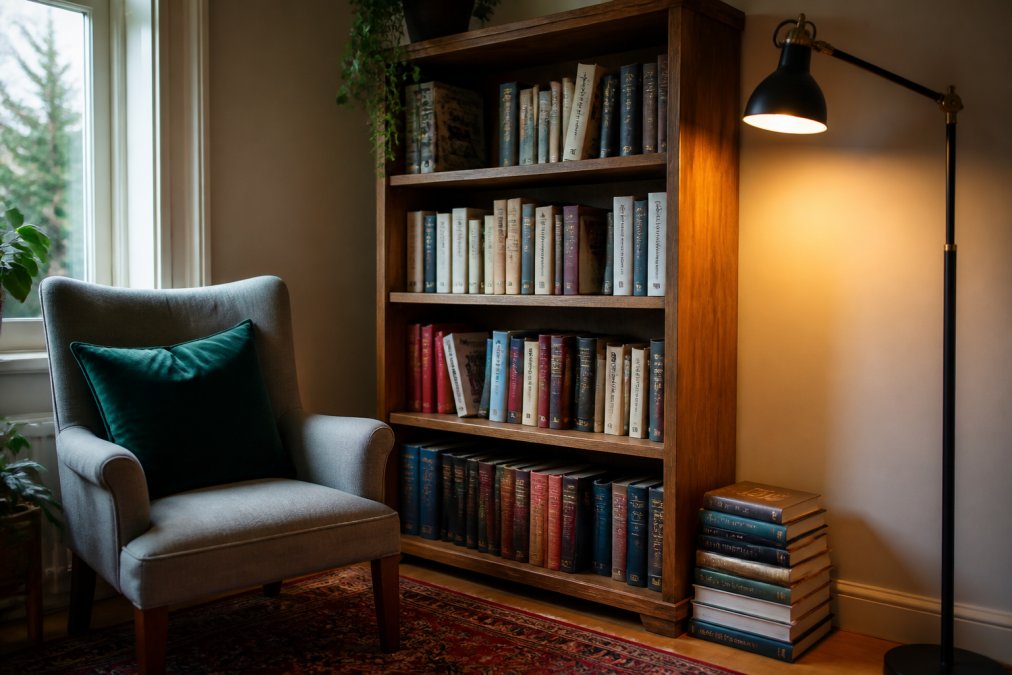
Matching the Unit to the Room
There is no single best bookcase, only the best one for the wall you actually have. The four formats that cover most homes are:
- Low, wide units (under 90cm tall). The safest option for renters and households with young children, because they need no wall fixing and double as a surface for a lamp or plant. They waste the wall above them.
- Tall narrow units (180-220cm tall). The best books-per-square-metre ratio and the standard choice for a dedicated wall. They must be anchored.
- Built-in or alcove shelving. Made to measure for chimney breasts, under stairs or awkward recesses. The most expensive per metre but the only option that uses every centimetre.
- Modular cube systems. Flexible and easy to reconfigure, but the fixed cube height wastes space on tall hardbacks and the open backs collect dust.
Wall Anchors, Book Weight and Shelf Spacing
Tall units must be fixed to the wall. Freestanding bookcases over about 60cm tall are a genuine toppling risk, particularly in homes with children or pets, and the risk rises sharply once the top shelves are loaded (Health and Safety Executive guidance on furniture safety).
- Anchor every unit taller than waist height into a stud or use appropriate masonry fixings for solid walls
- Keep shelves to a maximum 80cm span to limit bowing; 60-70cm is safer for heavy hardbacks
- Allow 25-30cm spacing for paperbacks, 32-35cm for hardbacks
- Place the heaviest books on the lowest shelves
- Leave the top shelf for light, decorative or oversized items rather than dense rows of hardbacks
For renters who cannot drill into walls, an anti-tip strap fixed to a stud is the usual compromise, and it is worth asking a landlord before installing anything permanent. A freestanding unit pushed into a corner and braced against a side wall is more stable than one standing in open space.
Space-Saving Solutions for Small Flats
Most guides assume a dedicated room. If you are working with a single wall, a shared living space or a studio flat, the goal is vertical density rather than floor footprint.
- Run shelving to the ceiling and use a small step stool for the top two rows
- Use the dead space above doorways for a shallow shelf of paperbacks
- Choose a depth of 20-25cm rather than the standard 30cm, which is enough for most fiction and frees floor space
- Consider a slim column unit in a hallway or beside a chimney breast
- Use under-bed storage boxes for the to-read pile, not for anything you need to browse
Shelf maintenance matters too. Check for sag every few months and rotate heavy volumes to redistribute the load. A shelf that has bowed by a few millimetres will not recover, so catch it early and move the weight down.
3. Used Books vs New Books: What Belongs on Your Shelves
Used books win on almost every measure that matters for a home library: cost, sustainability and character. A pre-loved hardback often costs a fraction of its new equivalent, and buying second-hand keeps a readable copy out of landfill.
New books still have a place. If you need a current edition for reference, or you're buying a gift, new makes sense. For building a personal library of fiction, classics and military history, second-hand is the smarter default.
Condition is the real question, not age. Check the spine for cracks, the pages for foxing and the binding for looseness. A well-kept 1970s hardback will outlast a cheap modern paperback.
4. Home Library Organisation Ideas That Actually Work
The best home library organisation system is the one you'll actually maintain. Forget colour-coordinated shelves if you can never find anything; sort by how you search, not how it photographs.
Most readers search by genre first, then author. That gives you a simple, durable structure:
- Fiction by genre, then author surname
- Non-fiction by subject, then author
- Reference and oversized titles on a separate shelf
- A dedicated to-read pile, kept visible
Keep the to-read pile somewhere you'll see it daily. Books that disappear into a closed cupboard tend not to get read.
A Simple Cataloging System for Home Use
A home cataloging system doesn't need library-grade software, but it does need a consistent method. The two systems worth knowing are the ones public libraries actually use, and both can be simplified for a home shelf.
Dewey Decimal Classification (DDC) divides all knowledge into ten main classes, from 000 (computer science and information) through to 900 (history and geography). For a home library, you rarely need more than the first two or three digits. A shelf of military history sits in the 355-359 range; a shelf of cookery sits around 641.6. The advantage is that related subjects end up next to each other without you having to invent a scheme.
Library of Congress Classification (LCC) uses letters instead of numbers, with D for general history, E-F for the Americas, and so on. It suits larger collections and is the system most university libraries use. For a home library under a few hundred books, DDC is usually the easier starting point because the numbers are shorter.
If neither appeals, a simple genre-and-author scheme is perfectly valid. The point is consistency, not correctness.
Choosing Between a Spreadsheet and an App
A spreadsheet with five columns: title, author, genre, shelf location and date acquired, covers most collections and costs nothing. Add a sixth column for condition if you buy a lot of second-hand stock, so you can spot which volumes need repair before they deteriorate further.
Apps like LibraryThing, Goodreads and StoryGraph work too, and they have one real advantage over a spreadsheet: you can scan a barcode instead of typing. That matters once you pass a few hundred books. The trade-off is that app data lives on someone else's server, and a spreadsheet you control will still open in ten years.
A practical hybrid is common among collectors: use an app for cataloguing and discovery, and keep a spreadsheet export as your backup. Update it when you shelve new arrivals, or it becomes useless within a month.
Integrating Digital and Physical Shelves
Most guides ignore the fact that many readers now own ebooks and audiobooks alongside print. The simplest approach is to record format in your catalogue and treat the digital titles as a separate shelf location, for example "Kindle" or "Audible". That way a search for a title tells you whether you already own it, in which format, and where to find it. It stops the common pattern of buying a book twice because you forgot it was already on your e-reader.
5. Building a Personal Library on a Budget
Building a personal library on a budget comes down to buying strategically rather than cheaply. Second-hand shops, charity sales and online pre-loved retailers all let you add quality titles for very little, as long as you know what you're looking for.
Set a monthly book budget and stick to it. Many collectors find that a small, regular spend beats occasional large hauls, both financially and in terms of what actually gets read.
For a thoughtful gift, The Almost New Book Shop gift card at £5.00 lets a fellow reader choose their own pre-loved treasure. It's a low-risk way to introduce someone to second-hand buying.
6. Book Preservation, Climate and Shelf Maintenance
Book preservation is mostly about controlling three things: light, moisture and pests. Get those right and your collection will outlast you.
Sunlight exposure is the most common cause of faded spines and yellowed pages. Keep shelves out of direct sun, or fit UV-filtering blinds. For a deeper look at how light and humidity affect paper, the British Library's preservation guidance is an excellent reference.
Climate control in a UK home usually means managing damp rather than heat. Aim for stable indoor humidity and avoid shelving books against cold external walls, where condensation forms.
- Dust shelves monthly with a dry microfibre cloth
- Keep books upright, not leaning, to protect bindings
- Store oversized volumes flat
- Check for silverfish and booklice in dark, damp corners
Shelf maintenance is unglamorous but it's what separates a collection from a pile.
7. Create a Reading Sanctuary: Nook, Light and Comfort
A reading sanctuary needs three things: good light, a comfortable seat and a shelf within arm's reach. Everything else is decoration.
Position your reading nook near natural light but out of direct sun. A task lamp with a warm bulb handles evenings. A supportive chair matters more than a stylish one; you'll read for longer in something you can actually sit in.
Book display is part of the appeal. Face a few favourite covers outward, rotate them monthly, and let the shelf do some of the inviting. A small plant or a single object breaks up the rows without clutter.
Conclusion: Your Home Library Starts With One Shelf
The hardest part of starting a home library is beginning. One shelf, a dozen books and a chair is a home library. Everything after that is refinement.
At The Almost New Book Shop, we make that first shelf affordable and sustainable. Our curated selection of pre-loved fiction, non-fiction, classics and military history gives you quality titles without the new-book price tag, and every purchase keeps a readable book out of landfill. Whether you're after a rare military history title or a stack of children's books, our community of readers is built on the belief that great stories deserve a second chapter.
Get started with The Almost New Book Shop and build a collection you'll actually read. Subscribe to our emails for new arrivals and reading recommendations.
Frequently Asked Questions
How much does it cost to start a home library?
Most people can set up a basic home library for under £100. A second-hand bookcase might cost £20 to £50, and pre-loved paperbacks typically run from £2 to £5 each. If you buy ten to fifteen titles to begin with, that is roughly £30 to £70. The Almost New Book Shop gift card at £5.00 is a simple way to start or add to a collection without overspending.
How do I choose between buying new or pre-loved books for my collection?
Pre-loved books usually cost a fraction of new retail prices and keep readable copies out of landfill, which matters if you are building a collection on a budget. New books make sense for recent releases, signed editions or titles you want in pristine condition. For most fiction, classics and children's books, a good second-hand copy reads exactly the same and leaves more room in your budget for more titles.
What does every home library need to get started?
You need three things: a stable shelf or bookcase that can carry the weight, a simple way to sort your books so you can find them, and a dry spot away from direct sunlight. A shelf, a reading lamp and a loose cataloging method (a notebook or a free app) are enough. Everything else, such as a reading chair or decorative bookends, can be added over time as your collection grows.
What is the best way to organise a growing home library?
Start with broad categories, then refine. Group fiction by genre or author surname, keep non-fiction by subject, and give children's books their own low shelf. Leave about 20% empty space on each shelf so new arrivals have a home. If you pass 200 books, a simple cataloging system using a spreadsheet or a free app like LibraryThing or Goodreads will save you time when you cannot remember where a title went.
How can I make my home library more sustainable?
Buying second-hand is the single biggest step. Every pre-loved book you take in is one fewer new copy printed and one fewer book sent to landfill. Beyond sourcing, keep books dry and out of direct sunlight so they last, pass on titles you no longer want rather than binning them, and consider a book swap with friends or a local reading group. Small habits add up across a collection.
How do I protect my books from damp, dust and sunlight?
Keep shelves away from radiators, windows and outside walls where condensation forms. Aim for a room with steady temperature and low humidity; a cheap hygrometer helps you check. Dust shelves monthly with a dry microfibre cloth, and use a shelf with a back panel or a curtain to block direct light. Books stored spine-out and not packed too tightly let air circulate and reduce mould risk.