

How to Care for Antique Books at Home: 2026 Guide
Table of Contents
- What You'll Need Before You Start
- Best Storage Conditions for Rare Books
- How to Clean Old Book Pages and Covers
- Identifying Mould on Antique Books
- Handling and Protecting Fragile Bindings
- DIY Repair vs Professional Restoration
- Digital Cataloging and Insurance for Your Collection
- Conclusion
- Frequently Asked Questions
Last Updated: September 18, 2026
What You'll Need Before You Start
Caring for antique books at home starts with a small, inexpensive kit. You don't need a conservation lab, just a few basic supplies and a bit of patience. At The Almost New Book Shop, we handle pre-loved and vintage volumes every week, and the same handful of tools keeps them stable.
Gather these before you touch anything:
- A soft pony-hair or hake brush for dusting
- Nitrile gloves (not cotton, which snags on fragile paper)
- A digital hygrometer to read relative humidity
- Acid-free tissue and an archival storage box
- A rigid book support or book cradle for open volumes
- Microfibre cloths and a pH-neutral cleaner for leather only
Best Storage Conditions for Rare Books
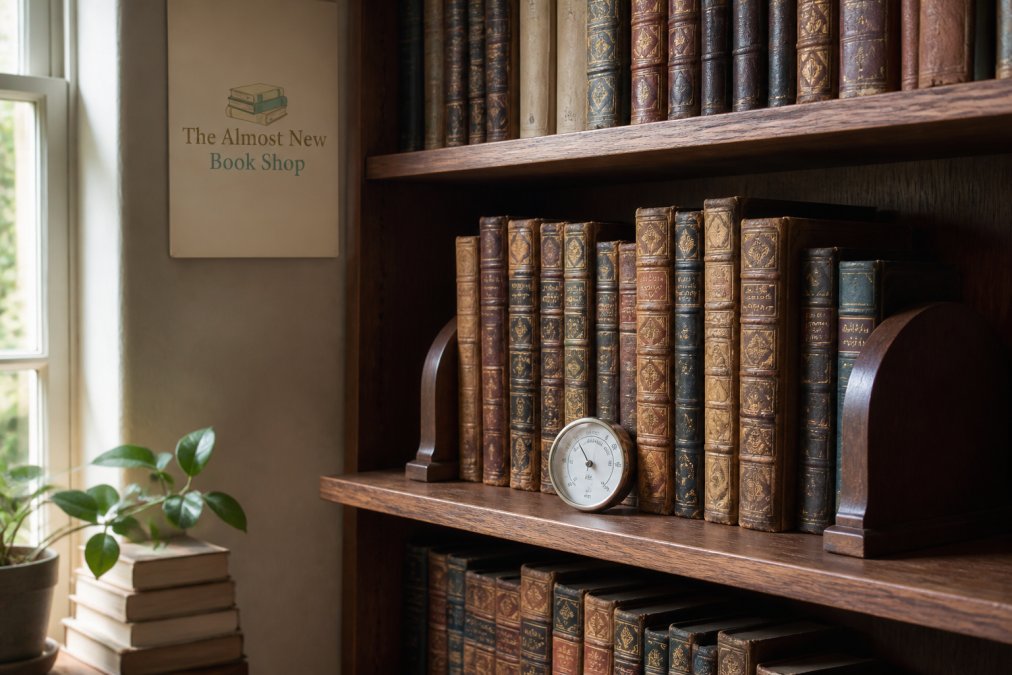
The best storage conditions for rare books keep temperature steady, humidity moderate, and light low. Aim for a stable environment rather than a perfect one. Fluctuation causes more damage than a slightly warm room.
Temperature and Humidity
Target 16-20°C and 45-55% relative humidity. Those are the ranges most conservators work within, and a cheap hygrometer tells you where you stand.
Shelving and Book Support
Shelve books upright, packed closely enough to support each other but not so tight you drag them out. Use bookends to stop lean. For oversized volumes, lay them flat and never stack more than two. Keep shelves away from external walls, radiators, and direct sunlight, since UV radiation fades spines and weakens paper.
How to Clean Old Book Pages and Covers
Cleaning old book pages means dry methods first, always. Water and liquid cleaners cause tide marks and swell the paper. Start gentle and stop the moment you see any change.
Dry Cleaning Methods
Work over a clean surface with good light. Hold the book closed and brush the top edge downwards, away from the spine, so dust falls out rather than into the binding. Then open it in a book cradle and brush each page toward the gutter.
Identifying Mould on Antique Books
Identifying mould on antique books comes down to smell, sight, and touch. A musty, earthy odour is the first sign. Grey or black powdery patches, often near the spine or page edges, confirm it.
Handling and Protecting Fragile Bindings
Fragile bindings fail from handling, not age alone. Support the book every time you open it.
Follow these handling protocols:
- Wash and dry your hands, or wear nitrile gloves for leather and metal fittings.
- Open the book on a flat surface, never in mid-air.
- Support both boards evenly so the spine isn't forced.
- Turn pages from the top corner, slowly, without pulling.
- Photograph or scan delicate pages instead of repeated handling.
DIY Repair vs Professional Restoration
Most guides tell you to leave everything to a conservator and stop there. That's unhelpful if you own a £15 Victorian reprint with a loose hinge. The honest position is that a small number of repairs are genuinely safe for a careful hobbyist, and everything else is not. The dividing line is reversibility: if the fix can be undone without leaving residue, staining, or structural change, it's usually fair game.
What You Can Safely Do Yourself
These are the jobs where the worst realistic outcome is that you've wasted a few pounds on supplies:
- Dusting and dry cleaning. A pony-hair brush and a smoke sponge lift surface grime without touching the paper's chemistry.
- Rehousing. Moving a book into an acid-free box with acid-free tissue supports it without altering the object at all.
- Tying loose boards. Cotton tape or unbleached linen tape, tied loosely around the boards, holds a detached cover in place while you decide on repair. Never tape across the spine itself.
- Encapsulating a single loose page. A polyester sleeve (Melinex or equivalent archival polyester) protects a fragile page without adhesive. Don't seal it, a sleeve you can open is reversible; a laminated page is not.
- Consolidating a lifting corner with wheat starch paste. This is the one adhesive job a hobbyist can attempt, and only on a low-value book. Wheat starch paste is reversible with moisture, unlike PVA or household glue. Apply the smallest possible amount with a fine brush, weight it lightly, and let it dry flat.
What Must Go to a Conservator
- Rebackings and spine replacements. These need specialist adhesives, matching cloth or leather, and a press. A home attempt usually ends with a stiff, obviously repaired spine that reduces value.
- Text block reattachment. Structural, and easy to ruin permanently.
- Washing, deacidification, or stain removal. These involve solvents and pH chemistry. A wrong call can bleach or burn the paper.
- Mould and water damage. Treatment needs containment and, often, fumigation-adjacent methods you can't replicate at home.
- Anything on a book worth more than a few hundred pounds. Get a written quote first. A conservator's fee is almost always less than the value a botched repair destroys.
The Materials That Matter
If you're going to do minor work, buy the right consumables once:
- Wheat starch paste, reversible, pH-neutral, the conservator's standard adhesive.
- Japanese tissue (kozo or gampi), long-fibred, strong, and nearly invisible when used for tear repair.
- Bone folder, for smoothing tissue and paste without tearing.
- Unbleached linen tape, for tying, not sticking.
- Nitrile gloves and a clean, lint-free surface, because oils from hands are a slow-acting adhesive and stain.
A Practical Decision Flow
- Is the book replaceable for under about £50? If yes, minor reversible fixes are reasonable.
- Is the damage structural (spine, text block, boards detached)? If yes, stop and get a quote.
- Does the fix involve adhesive, water, or heat? If yes, only wheat starch paste on a low-value book.
- Would undoing the fix leave a mark? If yes, don't do it.
- Are you unsure? Photograph it, store it flat, and ask a conservator. Most will give free initial advice by email.
Digital Cataloging and Insurance for Your Collection
No competitor covers this properly, and it's the part of home book care that protects you financially. A catalogued collection is easier to insure, easier to value, easier to replace after a flood or fire, and easier to hand on. It also gives you a condition record you can compare against in five years' time, which is the only reliable way to spot slow deterioration like foxing or spine creep.
What to Record for Each Book
A useful catalogue entry takes about five minutes. Include:
- A photograph of the title page (title, author, publisher, edition statement) and a photograph of the binding and spine.
- A photograph of any damage, foxing, tears, detached boards, previous repairs, dated.
- Bibliographic details: author, full title, publisher, edition, year, and any illustrator or translator.
- Physical details: binding type (cloth, leather, vellum, paper boards), size, number of volumes, and whether a dust jacket is present.
- Condition grade: use a simple scale, Fine, Very Good, Good, Fair, Poor, and note what pushes it down.
- Provenance and marks: bookplates, inscriptions, signatures, auction lot numbers, dealer receipts.
- Purchase details: date, seller, and price paid.
- Current estimated value: update annually.
Tools That Work at Home
You don't need specialist software. A spreadsheet with one row per book and a linked photo folder is enough for most collections. If you want something more structured, library cataloguing apps and general collection-management apps both work; the important thing is that the file lives in cloud storage, not only on one device. Keep a second copy on an external drive.
Valuing a Collection
For insurance purposes, you need a defensible figure, not a hopeful one. Three sources are usually enough:
- Recent sold prices for the same edition and condition from reputable auction houses and specialist book dealers.
- Dealer retail prices for comparable copies, these run higher than auction results because they include the dealer's margin.
- A written valuation from a qualified valuer or a member of a recognised trade association, for anything individually worth more than a few hundred pounds.
How Home Contents Insurance Treats Books
Most standard home contents policies cover books as part of the general contents sum, but with two common limits worth checking in your policy wording:
- A single-item limit. Many policies cap payouts per individual item, often around £1,000 to £2,000, unless the item is listed separately. A single rare book above that cap may not be fully covered.
- A total limit for collections. Some policies treat a book collection as one item and apply a separate, lower cap.
A Simple Maintenance Routine
- Monthly: back up your catalogue file.
- Quarterly: spot-check ten books against their catalogue photos for any change in condition.
- Annually: update values, review your insurance schedule, and re-photograph anything whose condition has shifted.
- After any move, flood, or pest sighting: re-inspect the whole collection and update the record.
Conclusion
Caring for antique books at home is really about stability: steady temperature, moderate humidity, gentle handling, and a record of what you own. Get those right and most volumes will outlast you.
Frequently Asked Questions
What is the ideal humidity for storing old books?
Aim for a relative humidity between 45% and 55%. Below 40% makes paper brittle and causes leather to crack; above 65% encourages mould spores to grow and accelerates foxing. Use a hygrometer to monitor levels, and a dehumidifier during damp months. Avoid placing books near radiators, windows or bathrooms where humidity swings are common. Stable conditions matter more than hitting an exact number, so check weekly and adjust gradually.
How can you tell if an old book is suffering from mould?
Look for powdery white, grey or green patches on covers, page edges or inside the spine. A musty, earthy smell is another sign. Mould spores feed on the paper and glue, causing permanent staining and weakening the binding. If you spot mould, isolate the book immediately, brush spores off outdoors while wearing a mask, and store it in a dry, ventilated space. Severe cases may need professional conservation.
Should old books be stored upright or flat?
Most antique books are best stored upright on a shelf, supported by bookends so they do not lean. This keeps the book spine and text block stable. However, oversized or very heavy volumes with weak bindings should lie flat to reduce stress on the spine. Never store books leaning at an angle for long periods, as this warps boards and loosens hinges. Use acid-free archival storage boxes for books with damaged covers.
How do you clean dust off antique book covers?
Use a soft, dry microfibre cloth or a soft brush to gently wipe dust from covers, working from the spine outward. For stubborn dirt on cloth or leather, a slightly damp cloth with a tiny amount of mild soap can help, but test on a hidden area first. Avoid soaking the cover, and never use household cleaners. For page edges, a soft eraser or a clean, dry paintbrush works well. Always support the book cradle-style while cleaning.
Building a home library shouldn't mean choosing between condition and cost. At The Almost New Book Shop, we curate pre-loved books with honest condition notes, keep prices accessible, and give every volume a second chapter. Start your collection with us and find titles worth keeping for decades.