

First Edition vs Reprint: What Actually Affects Book Value
Table of Contents
- First Edition vs Reprint: The Core Difference
- How to Identify First Edition Books
- First Printing vs First Edition: Why It Matters
- Why Most First Editions Are Not Valuable
- Factors Affecting Second-Hand Book Value
- Common Misconceptions About Collectible Books
- Building a Sustainable Collection Without Breaking the Bank
- Frequently Asked Questions
Last Updated: September 18, 2026
First Edition vs Reprint: The Core Difference
Understanding first edition vs reprint is essential: a first edition is the initial print run of a book released by a publisher, while a reprint is any subsequent printing of the same edition. This distinction matters for book collecting and value assessment, though many readers assume all first editions are inherently valuable. The difference between a first edition and a reprint comes down to scarcity and market demand, two forces that rarely align in the way collectors hope.
The reality is simpler than the mythology: a first edition is worth more only when collectors actively seek it. Without demand, scarcity means nothing.
People conflate "first edition" with "rare" and "rare" with "valuable." These are three separate things. A first edition can be common (millions printed). Rare books can be reprints (only 500 copies of the fifth edition exist). Valuable books can be neither rare nor first editions (a popular 1990s paperback reprint might fetch £50 because collectors want it).
How to Identify First Edition Books
Identifying a first edition requires checking specific markers on the book itself. The most reliable indicator is the number line on the copyright page, followed by examination of the dust jacket, binding, and publication details.
The Number Line and Copyright Page
The number line is a sequence of digits printed on the copyright page. For most modern books, the line reads: 10 9 8 7 6 5 4 3 2 1. If the lowest number is 1, it's a first printing. If the line reads 10 9 8 7 6 5 4 3 2 (missing the 1), it's a second printing. This system has been standard since the 1950s.
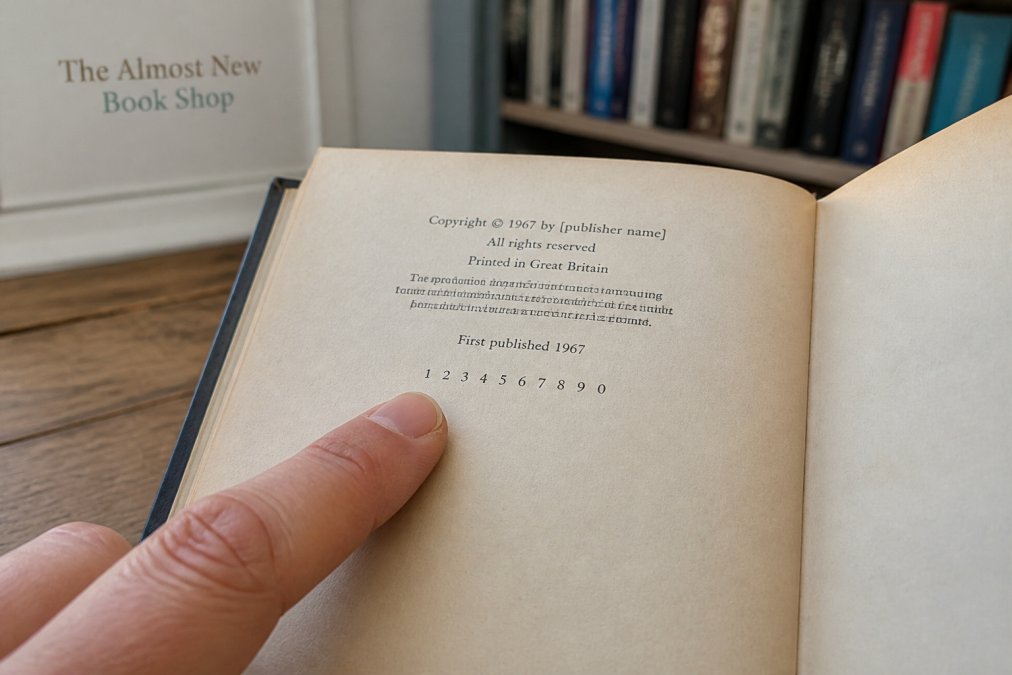
The number line should appear near the publication date and publisher information. Older books (pre-1950s) may lack number lines; instead look for "First Edition" or "First Printing" on the copyright page. British publishers sometimes used different conventions; check for "First published in [year]" without mention of subsequent printings.
Verify the publication date on the title page matches the copyright page date; mismatches indicate a later printing. Examine the dust jacket for "revised edition" or edition numbers, which suggest it's not a first edition.
Dust Jacket and Binding Clues
Original dust jackets from first editions often show age-consistent wear: fading, small tears, or spine creasing. If the jacket is pristine and the book shows age, you're likely looking at a reprint with a replacement jacket.
Early first editions often feature specific binding styles, cloth binding, or publisher's marks unique to the first printing. Reprints may have cost-cutting changes: cheaper paper, simplified binding, or different cover colours.
Check for publisher's marks or colophons on the spine or back cover. Original dust jackets display the original publisher's name and address; later reprints often updated or removed this information.
First Printing vs First Edition: Why It Matters
First printing refers specifically to the initial print run of a first edition. First edition can technically refer to any book from the first edition, even if it's from the second or third printing of that edition. The first printing of a first edition commands significantly higher premiums than later printings of the same edition.
A book published in 1960 might have had three printings (1960, 1962, and 1965), all considered "first edition" copies. But only the 1960 copies (first printing) are truly scarce. The 1962 and 1965 printings are reprints of the first edition, treated differently by collectors in terms of value.
For modern books, this distinction matters less because publishers typically release new editions rather than simple reprints. For classics and out-of-print titles, understanding first printing vs first edition can mean the difference between owning a £5 book and a £500 book.
Why Most First Editions Are Not Valuable
The vast majority of first editions have no special value. A first edition of a mid-list novel from 2010 is worth roughly the same as a reprint, often just a few pounds. The market cares about demand, not scarcity alone.
Valuable first editions share specific characteristics: small print runs (under 5,000 copies), out-of-print status, or authors whose reputation has grown since publication. A first edition of a Stephen King novel is valuable because millions of readers want them. An obscure 1970s romance novel is not, regardless of print quantity.
Condition matters enormously. A first edition in poor condition (water damage, missing pages, heavily marked) sells for pennies. The same book in near-mint condition with an intact dust jacket might fetch £50 or more. A rare book can be worthless if damaged.
Most first editions from the last 20 years have no collector value. Publishers print tens of thousands of copies for popular authors. Abundance destroys value. Unless an author becomes unexpectedly famous, first editions from recent years are worth 20-40% of the original retail price.
Factors Affecting Second-Hand Book Value
Book value depends on a constellation of factors that work together. Understanding each one helps you make smarter purchasing decisions when building your collection.
Condition, Dust Jacket, and Rarity
Condition grading follows a standard scale: "Fine" shows minimal wear; "Very Good" allows minor wear, creasing, or fading; "Good" shows obvious wear but remains readable; "Fair" indicates significant wear; "Poor" means damaged, possibly missing pages or binding.
An original dust jacket in good condition can double or triple a book's value. A missing dust jacket typically reduces value by 30-50%. Clipped jackets (price cut from corner) are worth less than unclipped ones.
Rarity affects value only when demand exists. A book printed in 500 copies is rarer than one printed in 50,000 copies, but if no one wants it, it remains cheap. A first edition of a beloved classic reprinted dozens of times can be worth more than a genuinely rare but forgotten title.
Demand and Literary Significance
Literary significance drives long-term value. Books studied in schools, referenced academically, or celebrated in literary circles hold value across generations. A Booker Prize winner's first edition is more likely to appreciate than a forgotten author's, even if the latter was rarer.
Market volatility affects modern fiction. A debut novel winning major awards might see its first edition jump in value, but if the author's next book disappoints, value plateaus. Celebrity memoirs or topical non-fiction can depreciate rapidly as cultural interest fades.
Provenance, the documented history of ownership, can add value. A first edition with a famous author's inscription is worth significantly more. Most second-hand books have no provenance beyond their previous owner, so this factor rarely applies to everyday collecting.
Common Misconceptions About Collectible Books
Many readers hold beliefs about book value that don't match reality. Clearing these up will save you money and frustration.
Misconception 1: All old books are valuable. Age alone doesn't create value. A book from 1920 is valuable only if people want it. A book's age matters only in relation to its scarcity and demand.
Misconception 2: First editions are always worth more than reprints. False. A reprint of a beloved classic might be worth more than a first edition of a forgotten novel. Value follows demand, not edition status.
Misconception 3: Digital editions are the same as physical first editions. They're not. Book collectors value physical objects. Digital files have no scarcity or collectible value.
Misconception 4: Condition doesn't matter if it's a first edition. Condition is everything.
Building a Sustainable Collection Without Breaking the Bank
Collecting sustainably means buying books you'll actually read and enjoy, not speculation. The best collections are built on personal interest, not investment potential.
| Factor | Impact on Value | What to Look For |
|---|---|---|
| First Printing | High | Number line reads "1" as lowest number |
| Condition Grade | Very High | Fine or Very Good condition preferred |
| Dust Jacket | High | Original, unclipped, minimal wear |
| Literary Demand | Very High | Books studied in schools, award winners |
| Rarity | Medium | Scarcity matters only with demand |
| Provenance | Low | Signature or notable ownership adds premium |
| Age | Low | Age alone doesn't determine value |
| Genre Popularity | High | Collecting trends affect prices |
Understanding book condition grading standards
The History of Modern Book Publishing and Print Runs
How to Assess Collectible Book Value Accurately
Frequently Asked Questions
How can you tell if a book is a first edition?
Check the copyright page for a number line (usually printed as 1 2 3 4 5...). If it starts with 1, it's a first printing of a first edition. Look for the phrase 'First Edition' or 'First Printing' explicitly stated. Examine the dust jacket for original publisher's price and design. Early reprints often have altered jacket designs or missing original pricing. The paper quality and binding can also differ between first editions and later reprints, though this requires experience to spot reliably.
What's the difference between first printing and first edition?
A first edition is the first published version of a book's text. A first printing is the first batch produced from that first edition. A book can be a first edition but a second printing if it was reprinted before any text changes were made. Collectors typically value first printing of a first edition most highly, as these are the earliest copies. Later printings of the first edition are worth less, even though the text is identical. The number line on the copyright page reveals which printing you hold.
Does a first edition always mean it is more valuable?
No. Most first editions are worth only slightly more than reprints, if anything. Value depends on rarity, condition, demand, and literary significance. A first edition of a bestselling modern novel in poor condition may be worth less than a carefully preserved reprint of a rare 19th-century work. Dust jacket condition dramatically affects price. Many first editions from the last 30 years were printed in large quantities, making them common and inexpensive. Authentication and provenance also matter, signed copies or those with notable ownership history command premiums.
What factors influence the market value of a rare book?
Scarcity, condition, provenance, and demand drive collectible book prices. A scarce title in excellent condition with an original dust jacket typically costs far more than the same title in poor condition or without its jacket. Literary significance and historical context matter, first editions of landmark novels or important non-fiction attract higher prices. Out-of-print status increases value only if demand remains. Military history and classics tend to hold value better than trend-dependent contemporary fiction.