

Second Hand Bookshop vs Oxfam Online: 2026 Comparison
Table of Contents
- Second Hand Bookshop vs Oxfam Online: The Quick Comparison
- How Condition Grading Actually Works
- Independent Bookshop vs Charity Shop: Price, Range and Curation
- Ethical Book Shopping UK: Where Your Money Actually Goes
- Best Places to Buy Used Books: A Decision Framework
- Algorithmic vs Curated Discovery: What You Find, and What Finds You
- Frequently Asked Questions
Last Updated: September 11, 2026
Second Hand Bookshop vs Oxfam Online: The Quick Comparison
The second hand bookshop vs Oxfam online debate comes down to a simple trade-off: browsing a physical shelf gives you certainty, while an online storefront gives you reach. This comparison from The Almost New Book Shop breaks down condition grading, pricing, ethics and discovery so you can decide where your next pre-loved read comes from.
Here's the part most guides skip: neither option is automatically cheaper or greener. It depends on what you're buying and how far it travels to reach you.
The quick verdict:
| Factor | Second Hand Bookshop | Oxfam Online |
|---|---|---|
| Condition check | Inspect in person | Trust the listing |
| Range | Limited to shelf space | Nationwide stock |
| Curation | Curated by staff | Mixed donations |
| Delivery | Immediate | Posted to you |
| Best for | Browsing, gifting | Out-of-print hunts |
How Condition Grading Actually Works
Condition grading is the vocabulary sellers use to describe wear, and it is the single biggest source of disappointment in the second-hand trade. The problem is that no universal standard exists, so "Good" can mean two very different things depending on who is writing the listing.
Most sellers work from a loose hierarchy that runs roughly: As New or Fine, Very Good, Good, Fair, and Reading Copy. The words are not regulated, and no trade body enforces them. That is why the same paperback can be listed as "Very Good" by one seller and "Good" by another with no dishonesty on either side.
Decoding the Standard Descriptions
A useful rule is to treat the label as a starting point and the description as the real specification. Look for these signals:
- As New / Fine, appears unread; no creasing to the spine, no inscriptions, dust jacket intact if issued with one.
- Very Good, read but cared for; may have a faint spine crease, a previous owner's name in pencil, or light shelf wear to the edges.
- Good, clearly read; expect a cracked or leaning spine, tanning to the page edges, a clipped jacket, or a remainder mark.
- Fair, complete and readable but visibly worn; loose hinges, foxing, water staining or a repaired tear are all possible.
- Reading Copy, the honest catch-all. Buy it to read, not to keep.
A seller who writes "spine creased, no loose pages, inscription on the half-title" is more trustworthy than one who writes "good condition" and nothing else, because the first seller has given you something to check against on arrival.
What 'Good' Means at a Charity Retailer
Charity retail grading tends to be generous because stock arrives in volume and moves fast. A book marked "Good" may have a cracked spine, a previous owner's inscription or sun-faded covers. That is fine for a beach read, less so for a gift. The trade-off is deliberate: staff are processing donations at speed, and the price reflects the uncertainty.
Grading at an Independent Bookshop
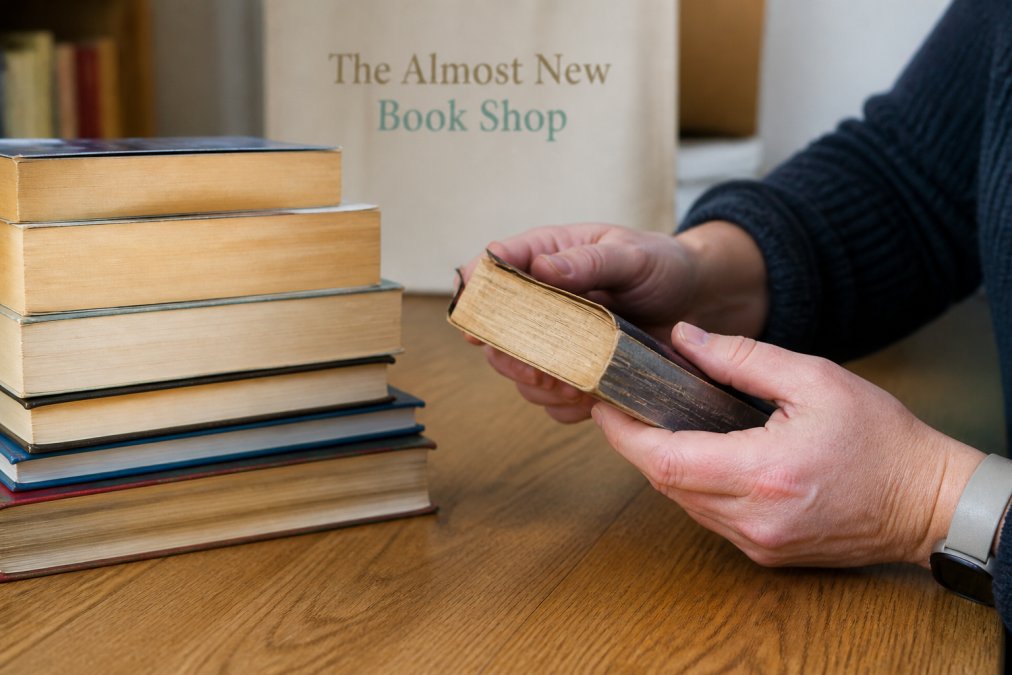
An independent bookshop usually grades by hand, one copy at a time. Staff can tell you whether the binding is tight, whether the jacket is clipped, and whether a rare edition has been restored. Ask for photos before buying online; a reputable seller will send them. If a listing shows a stock image rather than the actual copy, assume the description is doing all the work.
Your Rights If the Book Arrives Wrong
Under the Consumer Rights Act 2015, goods must be as described, of satisfactory quality and fit for purpose (legislation.gov.uk). A book sold as "Very Good" that arrives with a detached cover is not as described, and you are entitled to a repair, replacement or refund. Distance selling rules also give you a short cancellation window for online orders, though the position is different for bespoke or clearly personalised items. Check the seller's returns policy before you order, and keep the listing description, it is your evidence if the copy does not match.
Ask three questions before buying any collectable online: is the jacket price-clipped, is the binding square, and are there any ex-library stamps? The answers tell you more than the grade label ever will.
Independent Bookshop vs Charity Shop: Price, Range and Curation
An independent bookshop and a charity shop serve different purposes. The charity shop competes on price and volume; the independent competes on curation and knowledge.
Pricing in charity retail is often fixed and low, which suits casual readers. Independent sellers price by condition, edition and scarcity, so a first edition or a military history title can carry real value. That's price volatility in miniature: the same title can sell for a few pounds or several hundred depending on the copy.
Range is where charity retail struggles. Donations are unpredictable, so niche genres come and go. A curated shop builds its selection deliberately, which is why collectors return to the same seller for out-of-print and antiquarian titles.
Ethical Book Shopping UK: Where Your Money Actually Goes
Ethical book shopping is about more than the label on the shop door. It is about where the money lands, how far the book travels, and what happens to it afterwards. Most guides stop at "buy local, it's greener." That is too simple, so here is the mechanism behind each claim.
The Economic Multiplier Effect
Money spent with a local business tends to recirculate locally through wages, rent and further local spending. A common pattern cited by local-economy researchers is that a higher share of every pound spent with an independent stays in the surrounding area than a pound spent with a national chain or online platform (amiba.net). Charity retail also does good work, but its surplus flows to a national cause rather than the high street. Neither is wrong; they simply send your money to different places. If your priority is the shop two streets away staying open, the local purchase does more work per pound.
Carbon Footprint: Online Orders vs Shop Visits
The carbon comparison is not as one-sided as it first appears. Three factors decide it:
- The last mile. A single online order typically travels by van to your door. A walk to a local shop carries almost none of that. This is usually the dominant term.
- Packaging. Online orders arrive in card, plastic film or padded envelopes. Local purchases usually need none.
- Consolidation. If you batch several books into one online order, the delivery footprint is spread across more items, which narrows the gap considerably.
The practical rule: buy locally where you can, and where you cannot, order in batches rather than one book at a time. A single book ordered alone is the worst case on both carbon and cost.
According to WRAP's research on the circular economy, reusing products like books keeps them in use and avoids the emissions tied to making new ones. That principle applies whether you buy in a shop or online, the reuse benefit is usually larger than the delivery difference, which is why buying second-hand at all beats buying new.
What Happens to the Book Afterwards
An ethical purchase does not end at the till. A book bought locally is more likely to be re-donated locally, keeping it in circulation in your area. A book bought online may sit on a shelf until it is sold on again through a platform, which adds another delivery leg. If you want the longest possible life for a book, pass it on rather than storing it, charity shops, community book swaps and library sales all extend the chain.
Best Places to Buy Used Books: A Decision Framework
The best place to buy used books is the one that matches how you read, not the one with the biggest catalogue. Use this framework to choose.
- Buying a gift? Choose a shop where you can inspect the copy.
- Hunting a specific out-of-print title? Order online and ask for photos first.
- Building a children's library on a budget? Mix both: local for browsing, online for bulk.
- Collecting rare editions? Buy from a seller who grades by hand and knows the edition.
- Prioritising sustainability? Buy locally where you can, batch online orders where you can't.
At The Almost New Book Shop, we describe wear honestly. Titles like A Little Princess at £3.99 or The Midnight Fox at £3.50 show how affordable a curated children's shelf can be.


Algorithmic vs Curated Discovery: What You Find, and What Finds You
Algorithmic discovery shows you more of what you already buy. Curated discovery shows you what a human thinks you'd love. That difference shapes your whole reading life.
An online storefront's recommendations are driven by past behaviour, which is efficient but narrow. A bookseller's recommendation is a judgement call, and it's how most readers stumble onto a genre they'd never have searched for. Bibliophiles tend to trust the second approach.
This is where a pre-loved shop earns its keep. It can hand you a Lonely Planet guide for £4.99 or £5.99 and tell you why it's worth your shelf space.
Frequently Asked Questions
What is the best website for second-hand books?
There is no single best site, because the right choice depends on what you are buying. Large charity platforms suit popular paperbacks and bulk orders, while a curated second hand bookshop is better for specific titles, out-of-print editions and children's classics. Check how each seller grades condition, what they charge for delivery, and whether returns are straightforward before you commit to a large order.
Are independent second-hand bookshops cheaper than charity shops?
Not always on the sticker price. Charity shops often price popular paperbacks lower because stock is donated. Independents tend to price by condition, scarcity and demand, so a rare or out-of-print title costs more but is far more likely to be available at all. Once you factor in the cost of ordering several cheap books separately with individual delivery charges, a single curated order can work out comparable.
How does book condition grading differ between charity retailers and independent shops?
Charity retailers typically use broad labels such as acceptable, good or very good, and the description is often generated at scale. Independent shops often describe specific faults: a creased spine, a previous owner's inscription, sun-faded boards. If condition matters to you, look for sellers who list actual photographs of the copy you are buying rather than a stock image of the title.
Is buying second-hand books online better for the environment than shopping in person?
It depends on how the book reaches you. Reusing any book avoids the paper, printing and binding of a new copy, which is the largest saving. After that, a single delivery covering several books has a lower impact than several separate orders, and a local collection or shop visit avoids delivery miles altogether. Ordering in batches rather than one book at a time is the simplest way to reduce the footprint.
What should I check before buying a pre-loved book online?
Look for a written condition description rather than a generic label, and check whether the listing shows the actual copy. Confirm the edition and publisher if you are collecting, since reprints vary in value. Read the returns policy before ordering, and check the delivery cost against the book price. For children's books, ask about inscriptions and page markings, as these are common in pre-loved copies and rarely mentioned in short listings.
The real challenge isn't finding a used book; it's finding one that arrives in the condition you were promised. The Almost New Book Shop exists to close that gap, with a curated selection of pre-loved fiction, classics, military history and children's titles, each graded by hand and priced accessibly. Every purchase keeps a book out of landfill and puts it back in a reader's hands. Subscribe to our emails and be first to see the next shelf of rescued titles.