

How to Store Old Books: A 2026 Home Guide
Table of Contents
- Why Old Books Need Different Care
- Step 1: Choose the Right Storage Spot
- The Ideal Humidity for Book Storage
- Step 2: Pick the Best Shelving Method
- Step 3: Use Acid-Free Storage Boxes for Books
- Step 4: Learn How to Clean Old Books
- Step 5: Guard Against Pests and Light
- Keeping Track with a Digital Inventory
- Frequently Asked Questions
Last Updated: September 9, 2026
Why Old Books Need Different Care
Old books are not the same as new ones. Their paper is more fragile, their bindings are more brittle, and their inks are more sensitive to light and moisture. A book printed in 1960 can literally turn to dust if stored in a damp garage, while the same volume would survive decades on a well-managed shelf.
The difference comes down to a few core vulnerabilities: acidic paper that degrades over time, animal-based glues that attract pests, and cloth covers that fade and fox. Foxing, those small brown spots you see on older pages, is caused by mould and metal impurities reacting to humidity. This makes proper storage a genuine preservation task, not just organisation.
This guide walks you through five practical steps to keep your collection safe, covering everything from shelving to pest control. You will learn how to store old books in a way that protects them for years, whether you have two treasured volumes or two thousand.
Step 1: Choose the Right Storage Spot
The single most important decision is where you keep your books. Most guides miss this: the wrong room will undo every other precaution you take.
Avoid basements, attics, and exterior walls. These areas suffer from temperature swings and damp. A spare bedroom, a hallway cupboard, or a living room shelf away from radiators and windows is usually ideal. The space should be dark, cool, and stable.
Look for a spot with no direct sunlight and no obvious moisture sources like pipes or kettles. If you can, elevate your shelves a few centimetres off the floor. This protects against flooding and makes cleaning easier.
The Ideal Humidity for Book Storage
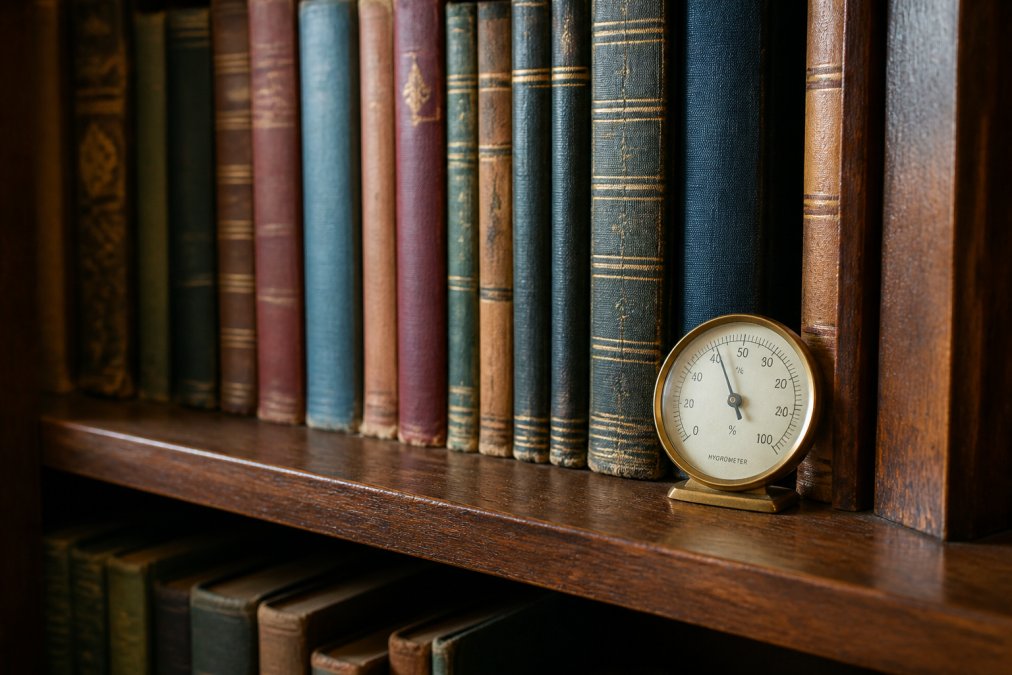
The ideal humidity for book storage sits between 30% and 50% relative humidity. This range keeps paper flexible without inviting mould.
You need a hygrometer to monitor this. These devices cost very little and take the guesswork out of preservation. If your home reads above 60% humidity, consider a dehumidifier for the room where you keep your collection.
Temperature matters too. Cooler is better, with 15-20°C being a comfortable target. Heat accelerates the chemical breakdown of paper, while cold slows it down. The key is consistency: sudden swings cause expansion and contraction that stress the spine and text block.
The British Library's preservation guidance on environmental conditions recommends monitoring these factors for any collection of value. Their conservation team considers stable conditions more important than chasing perfect numbers.
Step 2: Pick the Best Shelving Method
Books should stand upright, packed snugly but not tightly. This is the vertical shelving method, and it offers the best spine support for most volumes.
When you shelve old books vertically, ensure the spines are not pushed back flush with the shelf edge. Leave a few millimetres of clearance so your fingers can grip the spine without pulling on the headcap. That small cloth ridge at the top is fragile and tears easily.
For taller or oversized volumes that cannot stand upright, stack them flat. Limit stacks to three or four books high to avoid crushing the lower volumes. Never lean books diagonally; this puts uneven pressure on the binding and causes warping over time.
Step 3: Use Acid-Free Storage Boxes for Books
Acid-free storage boxes for books are essential for anything you want to protect long-term. These boxes use pH neutral materials that will not transfer acids to your pages. But archival-grade boxes from specialist suppliers can be costly, which is prohibitive if you have more than a handful of volumes worth protecting. This section bridges professional standards with practical, budget-conscious solutions you can implement at home.
Why Acid-Free Matters
Standard cardboard contains lignin, a wood polymer that produces acid as it breaks down. Over years of contact, this acid migrates into your books, yellowing pages and making them brittle. Archival boxes are lignin-free and buffered with an alkaline reserve (usually calcium carbonate) to neutralise acids as they form. The difference is measurable: a book stored in contact with acidic cardboard can show significant yellowing within five to ten years, while the same book in an acid-free enclosure will remain stable for decades.
A clamshell box is the gold standard. These open like a book, provide full protection from dust and light, and support the structure of fragile volumes. They are ideal for rare editions, first printings, or books with detached covers. However, for the average collector, a full set of clamshell boxes is rarely necessary. Reserve them for your most valuable or fragile items.
Budget-Friendly DIY Archival Solutions
For everything else, you can build effective protection using safe, accessible materials:
-
Acid-free tissue paper as a barrier. Wrap each book in unbuffered acid-free tissue paper before placing it in any box. A pack of 100 sheets can be found at art supply shops or online retailers. This creates a neutral barrier between the book and whatever container holds it.
-
Buffered interleaving for brittle pages. If you have a book with fragile or foxed pages, place a sheet of buffered acid-free paper between the text block and the cover. This slows the migration of acids from the cover materials into the pages.
-
Repurpose sturdy cardboard boxes with a liner. A clean, dry cardboard box (like a wine box or a copy-paper box) can be lined with acid-free tissue or a sheet of unbuffered archival paper. This prevents direct contact between the book and the acidic cardboard. Do not seal the box; leave it slightly open or punch a few small holes to allow air circulation.
-
Use cotton or muslin cloth for wrapping. Unbleached cotton muslin (available from fabric shops) is a safe, breathable wrap for books in storage. Avoid dyed fabrics, which can transfer colour, and never use plastic wrap or bin liners, which trap moisture.
-
Create simple book shoes from corrugated board. For books with weak hinges or detached covers, cut a piece of acid-free corrugated board slightly larger than the book, fold it into a U-shape, and slide the book inside. This supports the text block without putting pressure on the spine.
What to Avoid at All Costs
- Plastic storage bins with sealed lids. Trapped moisture creates a micro-climate that encourages mould growth and pest infestation.
- Newspaper or printed paper as wrapping. The inks and acids transfer readily to book covers.
- Self-adhesive laminating sheets or sticky labels directly on covers. The adhesive becomes permanent and damages the binding over time.
- Vacuum-sealed bags. These compress the book and can crush the spine or text block.
When to Invest in Professional Enclosures
If a book has significant monetary or sentimental value, say, a first edition worth more than £100 or a family heirloom with a handwritten inscription, the cost of a proper archival box is justified. Look for boxes from reputable UK archival suppliers that specify "lignin-free" and "buffered" on the label. A well-made clamshell box will outlast the book it protects and can be reused if you ever sell or donate the volume.
The paper your books touch matters as much as the air they breathe. Acid-free materials prevent the slow chemical damage that destroys older paper from the outside in.
Step 4: Learn How to Clean Old Books
Learning how to clean old books properly prevents damage and extends their life. The wrong technique, however, can grind dirt into the paper or rip fragile pages.
Start with a soft, dry brush. A natural bristle artist's brush works well. Hold the book closed and brush from the spine outward, gently removing dust from the edges of the pages and the cover. Work in one direction to avoid pushing dirt deeper.
For covers, use a barely damp cloth. Wring it out thoroughly so no moisture remains. Wipe gently, then dry immediately with a soft cloth. Never use cleaning chemicals, which can strip finishes and damage leather.
Dust jackets need special care. Handle them separately and store them in clear, archival-grade protective covers. This shields them from atmospheric pollutants and handling damage while keeping them visible.
The National Archives' guidance on book conservation and handling notes that regular gentle cleaning prevents the buildup of abrasive dust that damages paper fibres over time.
Step 5: Guard Against Pests and Light
Pests and light cause silent, irreversible damage. Silverfish and booklice feed on the starches in paper and glue, while UV radiation fades inks and embrittles paper.
Inspect your shelves regularly for signs of pest infestation. Look for tiny holes, powdery residue, or shed skins. If you spot trouble, isolate affected books immediately in sealed bags and freeze them for 48 hours to kill eggs and larvae.
Light damage is cumulative and permanent. UV radiation from windows fades spines and bleaches covers. Keep books out of direct sunlight and consider UV-filtering film on windows near your shelves. Even indoor lighting causes slow fading, so rotate displayed books periodically.
A book cradle is worth investing in for reading your oldest volumes. This simple support holds the book open at a safe angle, preventing binding stress and keeping the spine intact while you read.
Keeping Track with a Digital Inventory
Most collectors overlook inventory, and it costs them dearly. A digital inventory records what you own, its condition, and its value, which is essential for insurance and valuation. This is the one area where nearly every preservation guide falls short, they tell you how to keep books physically safe but never explain how to protect your financial interest in them. Here is how to build a practical system that works for a home collection.
Why Bother? Insurance and Valuation Realities
Standard home contents insurance in the UK typically covers books as part of your general contents, but there are important limits. Most policies cap individual items unless you list them separately. A single first edition of a popular children's book from the 1950s can easily exceed that threshold. If you have books worth more than your policy's single-item limit, you need to either add them as specified items or take out a separate valuable-items policy.
Insurers require proof of ownership, condition, and value before they will pay out. Without a dated photograph and a written condition note, a claim for a damaged or stolen book is likely to be disputed or reduced. This is not scaremongering, it is standard claims practice across UK insurers.
Building Your Inventory: A Step-by-Step Approach
Step 1: Create a spreadsheet with the right columns.
Set up columns for: title, author, publisher, publication year, edition (first, second, reprint), binding type (cloth, leather, paperback), condition grade (use a simple scale: Fine, Very Good, Good, Fair, Poor), estimated value, purchase price (if known), and notes on any damage or peculiarities (inscriptions, bookplates, missing pages, foxing).
Step 2: Photograph systematically.
For each book, take three photographs: the front cover, the spine, and the title page (which proves the edition and publisher). Add a fourth photo of any significant damage, a torn hinge, a detached cover, or heavy foxing. Use natural light and include a ruler or a coin in the shot for scale. Store these photos in a cloud folder organised by shelf or by author.
Step 3: Photograph your shelves as a whole.
A full-shelf photo helps insurers understand the scale of your collection and makes claims far easier to process. Take one wide shot of each bookcase and one closer shot of each shelf. Update these annually or whenever you add or remove a significant number of books.
Step 4: Record condition changes over time.
Old books degrade, and that degradation affects value. Note any developing foxing, loose hinges, fading covers, or signs of pest activity in your spreadsheet. This serves two purposes: it alerts you to problems before they worsen, and it provides a documented history of condition if you ever need to claim or sell.
Step 5: Set a review reminder.
Schedule a twice-yearly review (for example, at the clocks changing in spring and autumn). Check your shelves for new damage, update your photos, and adjust estimated values if the market has moved.
Estimating Value Without a Professional Appraisal
For most books, you can estimate value using online marketplaces. Search for the exact edition (matching publisher, year, and binding) and look at sold listings rather than asking prices. A book listed at £80 that has not sold in six months is realistically worth less. For a quick reference, the following rough benchmarks apply to the UK second-hand market:
- Common paperbacks from the 1970s-1990s can be found at various price points unless they are by a major author in collectible condition.
- Standard hardbacks from the mid-20th century vary in price depending on condition and demand.
- First editions of well-known authors can range significantly, sometimes more for iconic titles.
- Truly rare or association copies (signed, inscribed, or with provenance) often require professional appraisal.
These are indicative ranges, not valuations. If you suspect a book is very valuable, it is worth paying for a professional opinion.
Getting a Professional Appraisal
For very valuable volumes, get a professional appraisal. The Chartered Institute of Archivists' directory of accredited conservators can point you toward qualified professionals who understand different binding types and their specific preservation needs. A written appraisal can be an investment, and you should ask for a condition report alongside the valuation. Keep the appraisal document with your insurance paperwork, it is the single strongest piece of evidence you can provide in a claim.
A Note on Storage and Market Value
How you store a book directly affects its market value. A book with a faded spine, a cracked hinge, or foxed pages can lose 50-80% of its potential value compared with the same edition in Fine condition. The inverse is also true: a book stored correctly, away from light, in stable humidity, and supported properly on a shelf, retains its value far better than one left on a windowsill or in a damp garage. Your storage decisions are not just about preservation; they are about protecting a financial asset.
A digital inventory is the one preservation tool that costs nothing, takes an afternoon to set up, and pays for itself the moment something goes wrong. Combined with proper physical storage, it gives you complete confidence in the long-term safety of your collection.
Frequently Asked Questions
Should old books be stored upright or flat?
Most old books should be stored upright on a shelf, packed snugly but not too tightly, so the spine is supported. If a book is very large, heavy, or has a fragile binding, store it flat instead. Never lean books at an angle, as this puts uneven stress on the spine. For oversized volumes, stacking no more than two or three flat is safer than standing them upright.
Can you store old books in plastic bags?
Avoid storing old books in ordinary plastic bags. They trap moisture, which leads to mold growth and off-gassing from the materials. Instead, use a breathable, pH neutral option like an acid-free storage box for books. If you must use plastic, choose a specialist archival polypropylene bag, but make sure the book is fully dry first and leave the bag unsealed to allow air circulation.
What temperature and humidity are best for book preservation?
The ideal humidity for book storage is between 45% and 55% relative humidity. Keep the temperature cool and stable, ideally between 15°C and 21°C. Fluctuations are more damaging than a steady reading, as they cause pages to expand and contract. A simple hygrometer helps you monitor conditions, and a dehumidifier can be a worthwhile investment for older homes.
What is the best way to store very old books?
For very old or valuable books, focus on creating a stable micro-climate. Store them away from direct sunlight and heat sources, in a room with the ideal humidity for book storage. Use a book cradle or a custom clamshell box for support. Handle them with clean, dry hands to avoid transferring oils, and avoid opening the covers more than 90 degrees to prevent binding stress.