

How to Clean Second Hand Books: A 2026 Guide
Table of Contents
- What You'll Need Before You Clean Second Hand Books
- Quarantine First: Checking for Pests and Mould
- How to Clean Second Hand Books: Covers and Spines
- Cleaning Page Edges and Removing Surface Dirt
- How to Disinfect Used Books Safely
- How to Remove Musty Smell from Books
- When Not to Clean a Book
- Conclusion
Last Updated: August 15, 2026
What You'll Need Before You Clean Second Hand Books
Getting the right tools together first means you won't be tempted to improvise with something that could cause damage.
Here is what you'll need:
- A soft-bristled brush (a clean, dry pastry brush or dedicated book brush works well)
- Microfiber cloths - at least two, one dry and one lightly dampened
- A soft eraser (white vinyl or a kneaded eraser - avoid coloured or abrasive types)
- Isopropyl alcohol (70% concentration is the standard for book disinfection)
- Bicarbonate of soda (for deodorising musty books)
- Cotton buds for detailed work along the book spine and page edges
- A clean, dry, well-lit workspace
- Sealable bags or a sealed container for quarantine
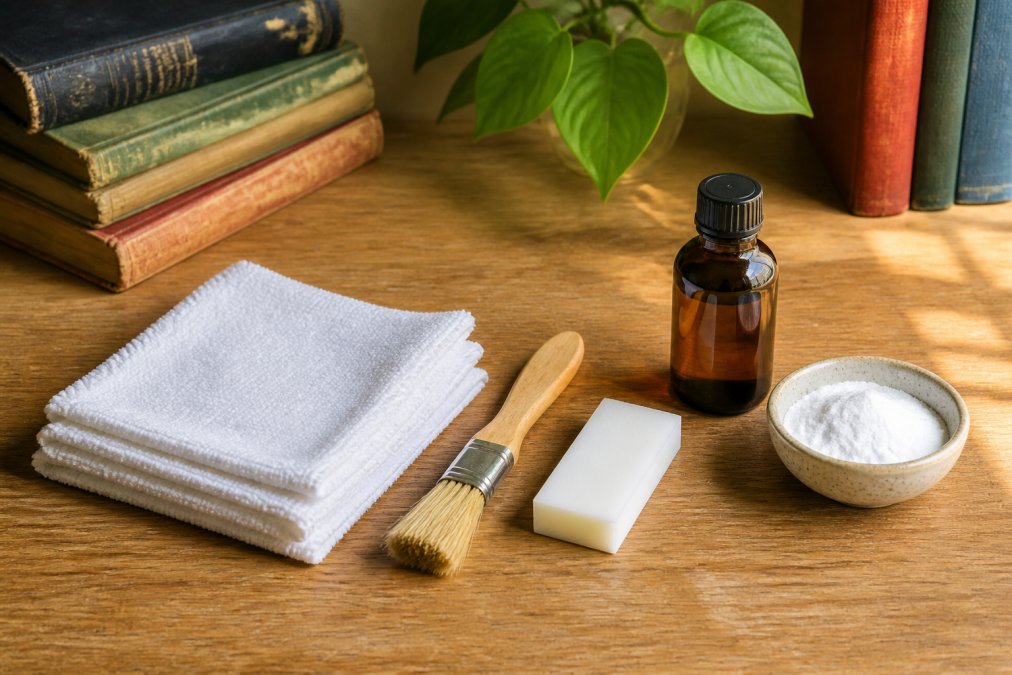
Not all tools are needed for every book. A lightly dusty paperback needs only a soft brush and a wipe, while a grimy hardcover might need the full kit. Assess the book first, then reach for your tools.
Quarantine First: Checking for Pests and Mould
The biggest mistake most people make when bringing second-hand books home is putting them straight on the shelf. Keep newly acquired books in a sealed container or separate room for 48 to 72 hours before inspecting them.
How to Spot Dust Mites, Silverfish, and Mould Spores
Dust mites are invisible but signal their presence through fine, powdery debris in the gutter or a faint musty odour. Silverfish leave obvious evidence: irregular notches along page edges, silvery scales, and small dark droppings.
Mould spores are more serious. Look for:
- Foxing - small reddish-brown spots on page edges or throughout the text block
- Fuzzy white, grey, or black patches on the cover or page edges
- A damp, earthy smell that doesn't fade after airing
- Discolouration that looks slightly raised or powdery to the touch
According to guidance from the Health and Safety Executive on biological agents and safe handling, mould exposure can pose genuine health risks, particularly for people with respiratory conditions. If a book shows active mould growth, handle it with gloves and consider whether it's worth attempting to salvage.
For light surface mould on a cover, a microfiber cloth lightly dampened with isopropyl alcohol can remove spores. For mould that has penetrated the pages, the book is likely beyond safe home cleaning.
Can You Freeze Books to Kill Pests?
Yes, freezing books is a legitimate pest-control method used by libraries and archivists. Placing an infested book in a sealed plastic bag and freezing it at -18°C or below for at least 72 hours kills silverfish, bookworms, and their eggs without chemicals.
The process requires care:
- Seal the book tightly in a zip-lock bag, removing as much air as possible
- Place it in the freezer at -18°C or colder
- Leave for a minimum of 72 hours
- Remove and allow the book to return to room temperature slowly, still inside the sealed bag, to prevent condensation
- Once at room temperature, open the bag and air the book for several hours before cleaning
This method is safe for most books but should be avoided for books with water-based inks, certain coated papers, or fragile bindings. The Institute of Conservation's guidance on book and paper care is a useful reference for archival quality or antique volumes.
How to Clean Second Hand Books: Covers and Spines
Covers take the most visible wear and require careful handling. The approach differs significantly between hardcovers and softcovers.
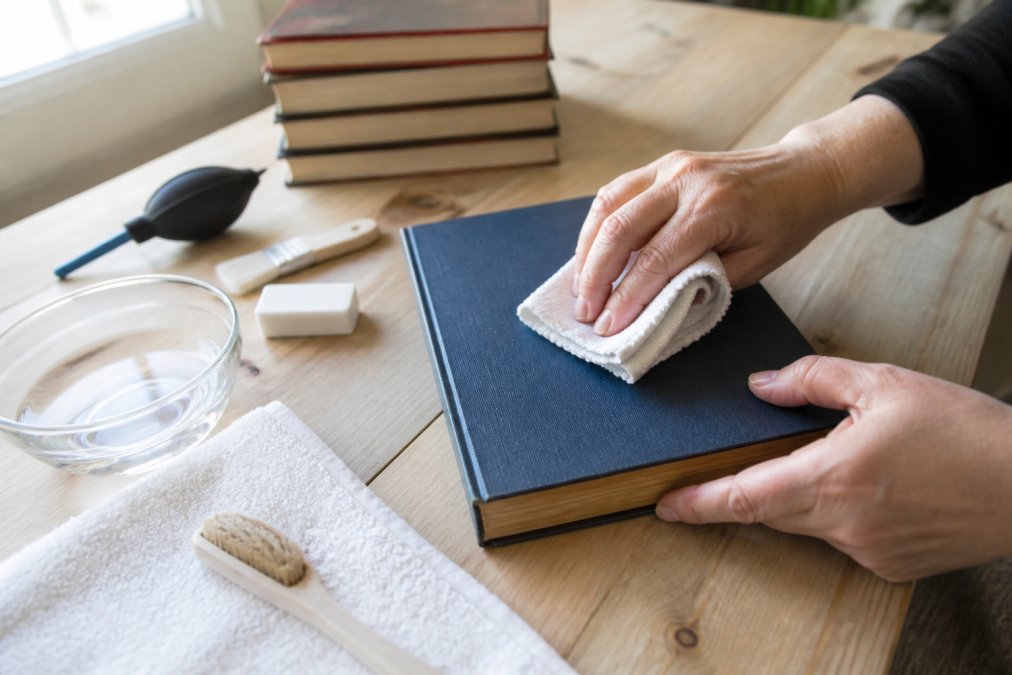
Cleaning Hardcover Books
For cloth-bound hardcovers: Use a dry microfiber cloth first to remove surface dirt. For stubborn marks, dampen the cloth very slightly with water and blot rather than rub. Never saturate cloth covers - moisture can cause warping and tide marks.
For laminated or glossy hardcovers: A microfiber cloth lightly dampened with water handles most surface dirt. For sticky residue or old price stickers, apply isopropyl alcohol to a cotton bud, let it sit briefly, then gently work it off.
For the book spine: Clean carefully with a dry brush first, then a barely-damp cloth if needed. Never flex or bend the spine while cleaning.
Dust jackets should be removed before cleaning the cover beneath. Clean the jacket separately with a dry microfiber cloth or a very slightly damp one for surface grime.
Cleaning Paperback and Softcover Books
Paperbacks are more vulnerable to moisture, so use minimal liquid. Start with a dry microfiber cloth to remove surface dirt and fingerprints. For marks on glossy covers, a very lightly dampened cloth is usually sufficient. Matt paperback covers are trickier - moisture can cause the surface to pill or look patchy.
For scuffs, a soft eraser used gently can lift surface marks. Work in one direction rather than scrubbing.
Adhesive residue responds well to isopropyl alcohol applied sparingly with a cotton bud. Too much alcohol on a paperback cover can cause ink to bleed or laminate to lift.
Cleaning Page Edges and Removing Surface Dirt
Page edges accumulate dust, skin oils, and environmental dirt. Cleaning them makes a significant difference to appearance and feel.
For general dust: Hold the book firmly closed and use a soft-bristled brush to sweep dust away from the spine outward, working from top downward.
For darker grime: A soft vinyl eraser used lightly along page edges can lift surface dirt. Hold the book tightly closed and use short, light strokes.
For sticky or greasy marks: A microfiber cloth barely moistened with isopropyl alcohol can address greasy marks. Apply minimal pressure and allow the area to dry completely before closing the book.
For vintage books or those with gilded page edges, avoid abrasive cleaning. A dry, soft cloth is safest.
| Surface | First approach | For stubborn marks | Avoid |
|---|---|---|---|
| Cloth hardcover | Dry microfiber cloth | Barely damp cloth, blotting only | Saturating with liquid |
| Glossy hardcover | Dry microfiber cloth | Isopropyl alcohol on cotton bud | Household sprays |
| Paperback cover | Dry microfiber cloth | Soft eraser, then barely damp cloth | Excess moisture |
| Page edges | Soft-bristled brush | Soft eraser or isopropyl alcohol | Abrasives, water |
| Dust jacket | Dry microfiber cloth | Very slightly damp cloth | Any solvents |
| Book spine | Dry brush | Barely damp microfiber cloth | Bending or flexing |
How to Disinfect Used Books Safely
Disinfecting used books is reasonable, particularly for children's books or those with compromised immune systems. Bacteria and viruses do not survive well on paper for extended periods, but cleaning is worthwhile for hygiene and peace of mind.
Isopropyl alcohol at 70% concentration is the standard tool for sanitising book covers. It kills bacteria and many viruses on contact, and rapid evaporation means minimal moisture exposure. Apply it to a microfiber cloth or cotton bud rather than spraying directly.
For covers:
- Dampen a microfiber cloth lightly with 70% isopropyl alcohol
- Wipe down the front cover, back cover, and spine
- Allow to air dry completely before shelving
For page edges, a light wipe with an alcohol-dampened cloth is sufficient. Do not attempt to disinfect individual pages - the moisture and handling would cause more damage than it prevents.
UV light sanitisers are sometimes recommended online but are impractical for reaching between pages, and prolonged UV exposure can cause paper to yellow and become brittle. Stick with isopropyl alcohol for reliable, low-risk sanitisation.
According to NHS guidance on hygiene and surface cleaning, standard cleaning with appropriate products is sufficient for managing surface bacteria in domestic settings.
How to Remove Musty Smell from Books
A musty odour signals the presence of mould spores or mildew, even when no visible growth is apparent. The good news: it's usually fixable.
Method 1: Bicarbonate of soda
Bicarbonate of soda is a natural deodoriser that absorbs odours without damaging paper:
- Place the book inside a sealed container or zip-lock bag
- Add a small open dish or sachet of bicarbonate of soda inside the container (do not let it touch the book directly)
- Seal the container and leave for 24 to 48 hours
- Check the smell and repeat if necessary
For heavily musty books, this process may need repeating two or three times.
Method 2: Airing
For mildly musty books, fresh air and light do most of the work. Stand the book upright with pages fanned open slightly in a dry, well-ventilated spot, out of direct sunlight. Sunlight can bleach and dry out paper, so indirect light is preferable.
Method 3: Activated charcoal
Activated charcoal sachets work on the same principle as bicarbonate of soda. Place the book and a charcoal sachet in a sealed container for 24 to 72 hours.
Spraying books with air freshener or fabric spray masks the smell temporarily but doesn't address the source, and moisture can worsen the underlying mould problem.
When Not to Clean a Book
Cleaning is not always the right call.
Do not attempt to clean a book if:
- It shows active mould growth that has penetrated the pages. Active mould is a health concern and unlikely to be salvageable without professional conservation.
- The binding is severely damaged or detached. Handling will accelerate the damage.
- The pages are brittle, yellowed, or foxed throughout. Antique and very old books with fragile pages are best left to professional conservators. The British Library's preservation and conservation guidance outlines when specialist intervention is appropriate.
- The cover has flaking, powdering, or red rot (a form of leather degradation). Rubbing will cause further deterioration.
- The book has significant sentimental or monetary value. First editions, signed copies, or rare volumes should be assessed by a professional before any cleaning.
Sometimes a book is too far gone to clean safely at home, and that's fine to acknowledge. A book with character, minor foxing, and honest wear is still worth reading. Not every imperfection needs correcting.
Book collecting is as much about accepting the history of an object as it is about preservation. The goal of book maintenance is to prevent further deterioration, not to restore every volume to pristine condition.
Frequently Asked Questions
How do you disinfect thrifted books safely?
The safest method is to wipe covers and page edges with a cloth lightly dampened with isopropyl alcohol (70% concentration). Allow full evaporation before closing the book. Never apply liquid directly to pages. For interiors, placing the open book in a sealed container with bicarbonate of soda for 24-48 hours reduces bacteria without risking moisture damage. This approach protects both the book and the reader.
Do dust mites live in old books?
Yes, dust mites can live in old books, particularly in the spine, between pages, and under dust jackets where dead skin cells and organic debris accumulate. They thrive in warm, humid conditions. A short quarantine period, gentle brushing of page edges with a soft-bristled brush, and storing books in a dry environment significantly reduce dust mite populations. Books showing signs of infestation should be isolated before joining your main collection.
How do you remove musty smells from old books?
Place the book in a sealed container or zip-lock bag with an open pot of bicarbonate of soda, or loosely crumpled newspaper, for several days. Both materials absorb odour without contact. For stronger musty odours caused by mildew, leave the book open in a well-ventilated area out of direct sunlight for a few hours first. Repeat the sealed-container method as needed. Avoid using scented products, which can damage archival-quality paper.
Can you use disinfectant wipes on book covers?
Disinfectant wipes are generally safe on laminated hardcover and paperback covers, but use them with caution. Wring out excess moisture before applying, and avoid the spine and any embossed or uncoated areas. Never use wipes on page edges or interior pages, as the moisture and chemicals can cause warping and discolouration. A cloth lightly dampened with 70% isopropyl alcohol gives better control and is safer for most book covers.
Pre-loved books bring a lot of joy, but the hygiene question is one we hear often at The Almost New Book Shop. Our customers deserve to know exactly what they're bringing into their homes, which is why we curate every title carefully before it reaches a new reader. If you'd like to stay up to date with our latest arrivals, cleaning guides, and tips for building a sustainable home library, subscribe to our emails and join a community of readers who believe every book deserves a second chapter.
This article was written using GrandRanker