

Lord of the Rings Book: The Complete Reader's Guide
Table of Contents
- What the Lord of the Rings Book Actually Is (And Why the Structure Confuses People)
- The Three Volumes: What Each One Covers
- The Lord of the Rings Reading Order: Where to Start
- Choosing the Best Lord of the Rings Book Box Set or Edition
- Frodo Baggins, the Fellowship, and the World of Middle-earth
- Why Pre-Loved Copies Are Worth Considering
- Conclusion
Last Updated: August 16, 2026
What the Lord of the Rings Book Actually Is (And Why the Structure Confuses People)
The lord of the rings book is one of the most misunderstood works in classic fiction, not because it's difficult, but because its physical packaging has confused readers for decades. The short answer is that it's a single novel published across three volumes.
J.R.R. Tolkien wrote The Lord of the Rings as one continuous narrative. His publisher, Allen & Unwin, split it into three volumes for practical reasons: paper costs were high in post-war Britain, and a single-volume release was commercially risky for an unknown fantasy work. Tolkien himself was never entirely happy about the division.
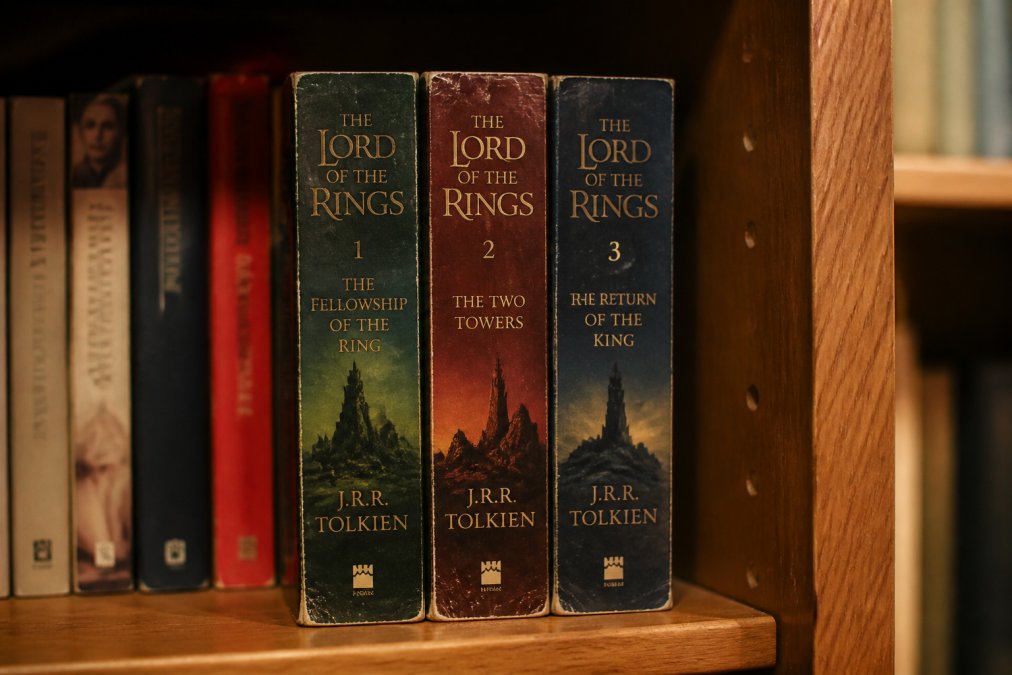
One Story, Three Volumes, Six Books
The three volumes are not the same as the six "books" Tolkien wrote internally:
- The Fellowship of the Ring contains Book 1 and Book 2
- The Two Towers contains Book 3 and Book 4
- The Return of the King contains Book 5 and Book 6 (plus appendices)
This matters because The Two Towers ends mid-sequence. Book 3 follows one group of characters, then Book 4 jumps back in time to follow Frodo and Sam. First-time readers sometimes think the narrative has broken. It hasn't. Tolkien was running parallel storylines and the volume break catches you mid-flow.
Publication History: 1954-1955
The Fellowship of the Ring and The Two Towers were published in 1954, with The Return of the King following in 1955. According to the British Library's overview of Tolkien's publishing history, the staggered release created immediate demand and helped establish the trilogy format that would define epic fantasy publishing for generations.
The Three Volumes: What Each One Covers
The Fellowship of the Ring
The Fellowship of the Ring introduces Middle-earth and the hobbit Frodo Baggins. Frodo inherits a mysterious ring from his uncle Bilbo and learns from the wizard Gandalf that it is the One Ring, forged by the dark lord Sauron to control all other rings of power. Frodo sets out from the Shire with companions, men, elves, a dwarf, and another wizard, to form the Fellowship of the Ring. This volume is the most accessible: pacing is gentle early on, world-building is rich but not overwhelming, and the central quest is clearly established. It ends on a shocking note that propels you directly into the next volume.
The Two Towers
The Two Towers increases narrative complexity. The Fellowship has broken apart, and the story splits across multiple threads. Frodo and Sam press on towards Mordor with Gollum as their guide, while other Fellowship members face war in Rohan. Battle sequences are long and the chapter structure can feel disjointed, but this is where Tolkien's world-building reaches its fullest expression: languages, histories, and geographies that feel genuinely ancient. The payoff in the final volume rewards every page.
The Return of the King
The Return of the King is the climax and, for many readers, the most emotionally powerful volume. War against Sauron reaches its peak as Frodo's quest to destroy the One Ring in Mount Doom drives towards conclusion. Tolkien doesn't stop at the dramatic climax, he follows his characters home, showing the cost of the quest in quieter, personal terms. The substantial appendices that follow are essential context rather than optional extras.
The Lord of the Rings Reading Order: Where to Start
Start with The Fellowship of the Ring and read the three volumes in publication order. The internal Book 1-6 structure doesn't change this, just read each volume front to back.
| Volume | Internal Books | Key Events | Best For |
|---|---|---|---|
| The Fellowship of the Ring | Books 1-2 | Shire to Rivendell, formation of the Fellowship | All new readers |
| The Two Towers | Books 3-4 | War in Rohan, Frodo's path to Mordor | Readers who want depth |
| The Return of the King | Books 5-6 + Appendices | Final battle, destruction of the Ring | Completing the story |
Should You Read The Hobbit First?
The Hobbit is not required reading before The Lord of the Rings, but it adds meaningful context. It introduces Bilbo Baggins, explains how he came to possess the Ring, and establishes the tone of the Shire. Tolkien wrote The Hobbit as a standalone children's adventure, so its register is lighter than the epic that followed. Many readers find that starting with The Hobbit eases them into Middle-earth more gently. Both approaches work.
Reading Level and Accessibility
The lord of the rings book is commonly recommended for readers aged 12 and above, though many younger readers with strong reading habits manage it comfortably. The prose is formal by contemporary standards: Tolkien was a professional philologist, and his sentence structures reflect that. Chapters vary considerably in density. Give it 100 pages before forming a verdict. The narrative structure rewards patience in a way that few works of fantasy literature do.
Choosing the Best Lord of the Rings Book Box Set or Edition
Picking the right edition depends on whether you're a first-time reader, a collector, or someone who wants the most complete and authoritative text available.
Single-Volume vs Three-Volume Editions
A single-volume edition presents the entire lord of the rings book as Tolkien intended: one continuous narrative without volume breaks interrupting the flow. These editions are typically heavier hardcovers, not ideal for commuting, but excellent for reading at home. Three-volume editions are more practical for daily use and easier to carry. For a first read, the three-volume paperback format is most accessible. For a permanent home library addition, the single-volume hardcover is more satisfying.
Collector's and Annotated Editions Worth Knowing
- The Annotated Lord of the Rings (edited by Douglas A. Anderson): Includes Tolkien's own illustrations alongside scholarly notes explaining textual history, sources, and revisions.
- The 50th Anniversary Edition: Published in 2004, this edition used a restored text correcting errors that had crept into earlier printings. According to the Tolkien Society's guide to editions, the restored text is now considered the definitive text for serious readers.
- Illustrated editions: Several editions feature artwork by Alan Lee or Ted Nasmith. These are visually beautiful and make excellent gifts.
- Deluxe slipcased box sets: These typically include all three volumes in matching hardcovers with a slipcase. They're the standard collector's choice.
Audiobook vs Print: Which Experience Suits You?
The audiobook version of the lord of the rings book is a genuinely different experience from reading the text. The most widely praised recording is narrated by Rob Inglis, who performs all characters with distinct voices and sings Tolkien's songs in full. For readers who find the prose density challenging, the audiobook can make the narrative more accessible. For those who want to engage with Tolkien's language closely, the poetry, invented languages, prose rhythm, print is better. Many dedicated readers do both: print for a first read, audiobook for a revisit.
Frodo Baggins, the Fellowship, and the World of Middle-earth
The lord of the rings book endures because its world feels genuinely inhabited rather than constructed. Middle-earth is the product of decades of Tolkien's linguistic and mythological work, giving everything in it a sense of depth and history.
Frodo Baggins is an unusual protagonist for high fantasy. He's not a warrior, not a king, not particularly brave by temperament. His defining quality is endurance: the capacity to carry an increasingly terrible burden further than anyone else could. The antagonist, Sauron, is largely absent as a physical presence, functioning as a dark lord whose influence corrupts and whose eye seeks constantly. The Fellowship itself, nine characters from different races united by a single quest, drives the first volume and casts a shadow over the remaining two. World-building is delivered through conversation, song, and environmental detail rather than exposition, rewarding rereading.
Why Pre-Loved Copies Are Worth Considering
A well-read copy of the lord of the rings book carries something a brand-new edition doesn't: evidence of previous readers. Pencil annotations in margins, a cracked spine from a favourite chapter, a name written inside the front cover. These aren't flaws, they're history.

Pre-loved editions make serious financial sense. Tolkien's works have been in continuous print since the 1950s, so good-quality second-hand copies are plentiful and affordable. A three-volume paperback set in solid reading condition typically costs a fraction of a new box set. For a reader who wants to try the books before committing to a collector's edition, buying pre-loved is the obvious move.
There's an environmental argument too. Publishing is resource-intensive, and buying a book that already exists avoids the paper, ink, and transport costs of producing a new one. At The Almost New Book Shop, we source pre-loved copies carefully, checking condition before listing them.
If you're looking for a gift for a Tolkien reader, The Almost New Book Shop also offers gift cards starting at £5.00, a straightforward way to let someone choose their own edition from a curated selection of pre-loved titles.

The lord of the rings book has been in print for over seventy years, and the question of which edition to buy, where to start, and how to approach the structure still catches new readers off guard. The Almost New Book Shop stocks pre-loved copies of Tolkien's works across a range of editions and conditions, making it easy to start your reading at an accessible price. Browse our curated fiction selection and subscribe to our emails for new arrivals, including the classics that deserve a second chapter.
Frequently Asked Questions
How many books is The Lord of the Rings?
Tolkien wrote The Lord of the Rings as a single continuous story, but it was published in three volumes: The Fellowship of the Ring, The Two Towers, and The Return of the King. Internally, those three volumes are divided into six 'Books' numbered I through VI, plus appendices. You may also find single-volume editions that bind all three parts into one hardcover, which is often described as the definitive text format for serious readers.
In what order should I read The Lord of the Rings books?
Read them in publication order: The Fellowship of the Ring first, then The Two Towers, then The Return of the King. This is both the chronological order and the order Tolkien intended. If you are new to Middle-earth, reading The Hobbit beforehand gives useful background on Bilbo, the Shire, and the One Ring, but it is not required. Many readers come to The Lord of the Rings first and return to The Hobbit afterwards.
Is The Lord of the Rings a difficult read?
It depends on your expectations. The prose is formal and rich, with lengthy descriptive passages, songs, and poems woven throughout. Chapters vary in pace, some sections move quickly while others, particularly the world-building passages in The Fellowship of the Ring, ask for patience. Most adult readers and confident teenagers manage it comfortably. If the opening chapters feel slow, pushing through to the Mines of Moria sequence usually settles any doubts about whether the story rewards the effort.
What is the difference between the single-volume and three-volume editions?
The text is identical. The single-volume edition binds all three parts into one book, which some readers prefer for continuity and as a collector's piece, though it is physically heavy. Three-volume editions are easier to carry and handle day to day. Some three-volume box sets also include the appendices in The Return of the King. Annotated and restored-text editions add scholarly footnotes and correct errors that crept into early printings, making them popular with literary scholars and dedicated fans.
Should I read The Hobbit or The Lord of the Rings first?
Either works, but most readers find starting with The Hobbit the gentler introduction. The Hobbit is shorter, lighter in tone, and written for a younger audience, which makes the transition into the epic scale of The Lord of the Rings feel more natural. That said, The Lord of the Rings stands entirely on its own. If you are drawn specifically to high fantasy and want to start with the bigger story, there is no rule stopping you from beginning with The Fellowship of the Ring.
This article was written using GrandRanker