

Are Used Books Safe From Mold? A Guide to Buying Second-Hand
Table of Contents
- Is It Safe to Buy Second-Hand Books?
- Identifying Mold vs. Foxing on Old Books
- Health Risks of Moldy Books: What You Need to Know
- Is Foxing the Same as Mold? Understanding the Difference
- How to Remove Mold from Books: A Step-by-Step Guide
- When to Salvage and When to Discard a Moldy Book
- Preventing Mold in Home Libraries: Long-Term Storage and Monitoring
- Frequently Asked Questions
Last Updated: September 22, 2026
Is It Safe to Buy Second-Hand Books?
Are used books safe from mold? In most cases, yes, used books safe from mold is the norm when they have been stored well. The risk is real but manageable, and it depends on how the book was stored.
Identifying Mold vs. Foxing on Old Books
Foxing is brown, speckled spotting on old paper, a chemical reaction in the paper itself, not a living organism. Mold is fungal growth, and looks and smells very different.
Here's how to tell them apart:
- Foxing: flat, brownish spots, no smell, dry to the touch, often on older titles
- Mold: fuzzy or powdery patches, white, grey, green or black, with a sharp musty odor
- Foxing: stable, it does not spread quickly once the book is dry
- Mold: active, it spreads and feeds on the paper's cellulose
Health Risks of Moldy Books: What You Need to Know
The health risk from a moldy book is not the mold you can see but what it releases when you open it. Disturbing a contaminated volume aerosolises spores, fine fungal fragments and volatile organic compounds (VOCs), the VOCs often trigger the headache and congestion people report.
What people actually react to:
-
Spores, inhaled, they can irritate the airways and trigger allergic rhinitis in sensitised people
-
Fungal fragments, smaller than spores, they travel deeper into the lungs
-
VOCs and microbial volatile organic compounds (mVOCs), responsible for the smell and for some of the headache and nausea complaints
-
Endotoxins and beta-glucans, bacterial and fungal cell-wall components that drive inflammatory responses in some people
-
Sneezing, runny or blocked nose
-
Itchy, watery eyes
-
Dry cough or throat irritation
-
Headache and a foggy, congested feeling
-
Wheezing or shortness of breath in people with asthma
-
Skin irritation where the book touched the forearms or hands
Assessing Risk for Immunocompromised Individuals
"Be careful if you're immunocompromised" is a disclaimer, not advice. Here is the risk across different groups.
Higher-risk groups:
- People on immunosuppressant therapy after transplant or for autoimmune conditions
- People undergoing or recently finished chemotherapy or radiotherapy
- People with advanced HIV, or on long-term corticosteroids
- People with cystic fibrosis, bronchiectasis or severe COPD
- People with a known mould allergy or allergic bronchopulmonary aspergillosis (ABPA)
- Infants and very young children, whose airways are smaller and who mouth objects
Moderate-risk groups:
- People with asthma or allergic rhinitis
- People with eczema or other atopic conditions
- Older adults with reduced respiratory reserve
Lower-risk groups:
- Healthy adults with no respiratory or immune conditions
Safety Precautions for Handling a Suspect Book
Whatever group you fall into, the handling rules are the same:
- Wear an FFP2 or N95 mask and nitrile gloves before you open the book
- Work outdoors, or at an open window with a cross-breeze
- Never shake, fan or riffle the pages, this is the single biggest spore-release action
- Keep the book downwind of your face, not upwind
- Do not eat, drink or touch your face while handling it
- Wash hands and forearms with soap and water afterwards, and change clothes if you were handling a heavily contaminated volume
- Wipe down the table or surface with isopropyl alcohol once you are finished
Is Foxing the Same as Mold? Understanding the Difference
No. Foxing is a chemical change in aged paper, often linked to trace metals and moisture exposure. Mold is living fungal growth that feeds on the paper. The two need opposite responses: foxing is harmless and needs no treatment, while mold needs containment, cleaning or disposal.
| Feature | Foxing | Mold |
|---|---|---|
| Appearance | Flat brown spots | Fuzzy or powdery patches |
| Colour | Brown, tan | White, grey, green, black |
| Smell | None | Sharp, musty odor |
| Texture | Dry, smooth | Powdery or damp |
| Spreads? | No, stable | Yes, if moisture remains |
| Action needed | None | Clean or discard |
How to Remove Mold from Books: A Step-by-Step Guide
Removing mold from books is possible if the infestation is dormant and the book is dry. If the pages are damp, soft or stuck together, stop. That book is past saving.
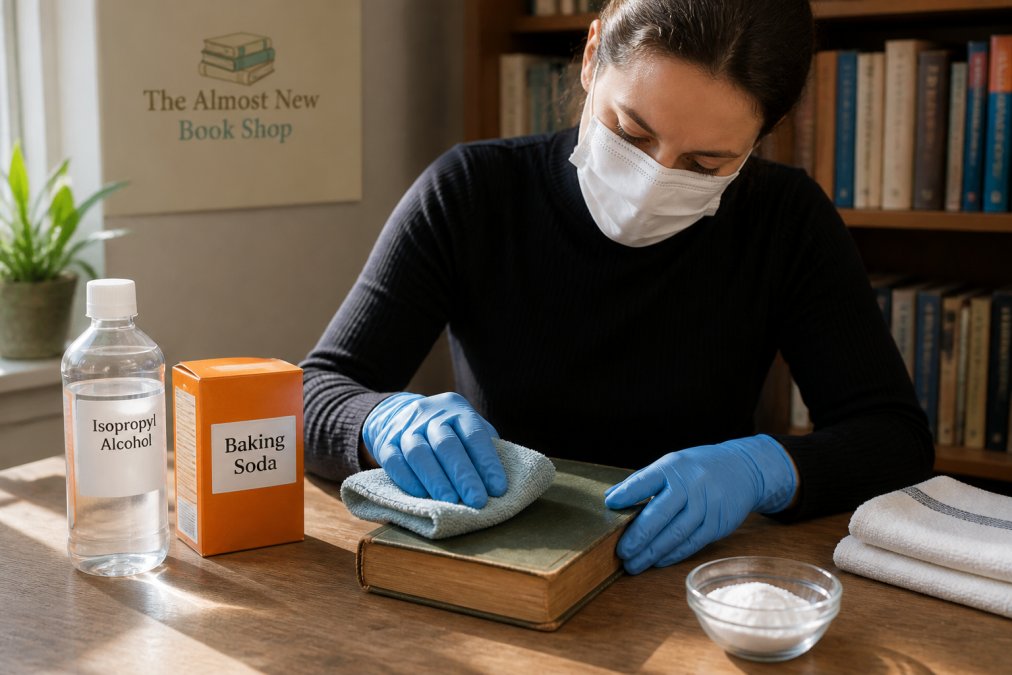
What you'll need:
- N95 or FFP2 mask
- Nitrile gloves
- Soft brush or HEPA vacuum with brush attachment
- Isopropyl alcohol (70%)
- Microfibre cloths
- Baking soda
- A sealed plastic bag for waste
Cleaning Glossy vs. Matte Pages
Glossy and matte pages need different handling; getting it wrong causes real damage.
Using Baking Soda and Other Odor Removal Techniques
Baking soda absorbs the musty odor left after visible mold is gone. It won't kill spores, but it makes a salvaged book pleasant to read.
The baking soda method:
- Sprinkle a thin layer of baking soda between the pages
- Stand the book upright in a sealed plastic tub
- Leave it for 3 to 5 days
- Brush or vacuum out the powder thoroughly
Other options that work:
- Activated charcoal in a sealed box, left for a week
- Fresh air and sunlight for an hour at a time, which also dries the paper
- A vinegar solution (one part white vinegar to four parts water) on the cover only, never the pages
When to Salvage and When to Discard a Moldy Book
Salvage if mold is on the cover only, the pages are dry and the odor fades after treatment. Discard if any of these apply:
- The pages are damp, soft or stuck together
- Black or green mold has spread through the page block
- The musty odor returns after cleaning
- The book is a risk to anyone in the household
- It's a cheap paperback you can replace easily
Safe Disposal Protocols for Contaminated Books
Do not put a moldy book in the recycling bin, and do not donate it. Both spread the problem.
- Seal the book in a plastic bag and tie it shut
- Put it in general waste, not paper recycling
- Never leave it in a charity donation pile
- Wipe down the surface it sat on with isopropyl alcohol
- Wash your hands and any clothing that touched it
Preventing Mold in Home Libraries: Long-Term Storage and Monitoring
Prevention is an environmental problem, not a cleaning problem. If the air around your books stays dry and moving, mould never gets a foothold; if it doesn't, no amount of spot-cleaning will keep up.
The three variables that matter, in order:
- Relative humidity (RH), the single biggest factor. Mould needs sustained RH above roughly 65% to germinate and grow on paper. Below 60%, growth stalls. Between 40% and 50% is the sweet spot.
- Temperature, warm air holds more moisture, and mould grows fastest between about 20°C and 30°C. Cooler, stable temperatures slow it down.
- Air movement, still air lets moisture settle. Gentle circulation prevents microclimates forming behind books.
Monitoring That Actually Works
A single hygrometer on a shelf tells you almost nothing. Here is a monitoring routine that does:
- Buy a calibrated digital hygrometer, cheap analogue dials drift badly. A digital unit with ±3% RH accuracy is the minimum. Expect to pay £10-£25.
- Place it where the books are, not where you are. A hygrometer on a desk reads the room; one tucked between books on the lowest shelf reads the shelf. Those can differ by 10% RH or more.
- Log readings weekly, not once. Mould needs sustained damp, not a single spike. A week of 70% RH is a problem; one humid afternoon is not.
- Watch the seasonal pattern. Indoor RH peaks in autumn and winter, when outdoor air is damp and windows are shut. Plan checks around the damp months.
- Check the coldest external wall shelf first. This is where condensation forms and mould appears first.
Storage Rules That Hold Up
- Keep shelves at least 5 cm clear of external walls, the condensation zone
- Avoid garages, lofts, cellars, conservatories and unheated spare rooms; these swing wildly in temperature and humidity
- Store books upright and not packed tight, so air can move between spines
- Leave a gap between the back of the books and the back of the shelf
- Never store books in sealed plastic boxes long-term, any moisture creates a microclimate
- If you must box books, use acid-free cardboard archive boxes with ventilation
- Keep books off the floor, especially on concrete or in rooms that have ever flooded
Equipment Worth Owning
- Digital hygrometer, £10-£25, the single most useful purchase
- Dehumidifier, for any room that regularly reads above 60% RH. Desiccant models work better in cold rooms; compressor models in warm ones.
- Small oscillating fan, run on low for an hour a day in a closed library room to break up still air
- HEPA vacuum, for shelves and suspect books. A standard vacuum exhausts fine particles back into the room; a HEPA unit captures them.
- Silica gel sachets, useful inside a display case or small sealed cabinet, useless in an open room. Replace or recharge regularly, as they saturate.
Seasonal Adjustments
- Autumn and winter: run the dehumidifier on a timer, target 45-50% RH. Keep windows closed during damp weather.
- Spring and summer: natural ventilation is usually enough. Open windows on dry days only, and avoid airing during rain or high pollen if anyone has allergies.
- After any leak, flood or damp work: monitor the room for at least a full season. Mould often appears weeks after the visible moisture is gone.
A Simple Six-Month Routine
- Monthly: read and log the hygrometer; glance at the coldest shelf for any change in smell or spotting
- Quarterly: HEPA vacuum shelves and behind books; check the backs of books on external-wall shelves
- Twice a year: inspect the oldest, least-moved and most valuable books, spine, page edges, endpapers
- Annually: review your storage layout. Any book that developed a musty smell in the last year is telling you something about its location.
The British Library's guidance on caring for paper collections recommends stable, moderate conditions with good air circulation, which is the same principle whether you own ten books or ten thousand. For anything genuinely rare or valuable, the National Archives' advice on storage and environmental conditions is worth reading before you commit a title to a shelf.
Frequently Asked Questions
Should you throw away books with mold?
If a book has an active infestation with visible fuzzy growth or a strong musty odor, it is often best to discard it to prevent spores from spreading to your other books. For books with dormant mold or light surface mildew, you can attempt to salvage them by cleaning with isopropyl alcohol and storing them in a dry environment. If the mold has penetrated deep into the pages or the book is severely warped, disposal is the safest option.
How do I sanitize thrifted books?
To sanitize thrifted books, start by wiping the covers with a cloth lightly dampened with isopropyl alcohol or a diluted vinegar solution. For the pages, you can use a HEPA vacuum on a low setting to remove dust and spores, or place the book in a sealed bag with baking soda for a few days to absorb odors. Always work in a well-ventilated area and wear gloves and a mask to avoid inhaling airborne contaminants.
Can you get mold out of old books?
Yes, you can remove mold from old books if the damage is not too severe. Use a soft brush or cloth to gently wipe away surface mold, then clean with a mild disinfectant like isopropyl alcohol. For musty odors, place the book in a container with baking soda or activated charcoal. However, if the mold has caused the paper to become brittle or stained deeply, it may not be fully reversible. Always dry the book completely before returning it to your shelf.
What are the health risks of moldy books?
Moldy books can release spores and airborne contaminants that may cause respiratory irritation, allergic reactions, and asthma attacks in sensitive individuals. People with weakened immune systems or pre-existing lung conditions are at higher risk of more serious infections. If you are immunocompromised, avoid handling moldy books altogether or use personal protective equipment and work in a well-ventilated space. If you experience symptoms like coughing, sneezing, or skin irritation after handling old books, consult a healthcare professional.